
Introduction
Cam switches are widely used electrical switching devices designed for controlling and switching AC and DC electrical circuits. They are particularly useful in motor control, industrial automation, power distribution systems, and measurement applications. These switches are known for their compact size, reliable switching performance, long service life, and robust construction using high-quality conductive and insulating materials. To protect cam switches from short-circuit currents, appropriate fuses or circuit breakers should be used within the electrical circuit.
What is a Cam Switch?
A Cam Switch is a rotary electrical switch that controls one or more electrical circuits by changing the position of internal contacts through the rotation of a handle and shaft. As the handle rotates to different positions, specially designed cams inside the switch open or close specific contacts, allowing different circuit functions to be controlled.

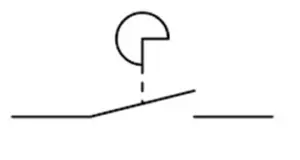
Cam Switch Symbol
Cam switches are extensively used in industrial automation systems to control, monitor, regulate, and sequence machine operations. Their ability to operate multiple contacts simultaneously makes them highly versatile for a wide range of electrical applications.
Features of a Cam Switch
- Compact and space-saving design.
- Reliable switching operation.
- Multiple poles and contact configurations.
- Easy installation and maintenance.
- Long mechanical and electrical life.
- Suitable for both AC and DC applications.
- High insulation and safety standards.
- Available in various switching arrangements.
Working Principle of a Cam Switch
The working principle of a cam switch is based on sequential make-and-break contact operations achieved through rotary movement. Inside the switch, specially shaped cams are mounted on a rotating shaft. As the operator turns the handle, the cams move and actuate different contact sets. This action either opens or closes electrical circuits according to the selected position. Because a single rotary movement can control multiple contacts, cam switches can perform several electrical functions using one device. When selecting a cam switch, the following factors should be considered:
- Number of poles
- Number of contacts
- Number of switching positions
- Operating voltage
- Current rating
- Application requirements
Cam Switch Wiring Diagram
One of the most common applications of a cam switch is as a Voltmeter Selector Switch in three-phase electrical systems.
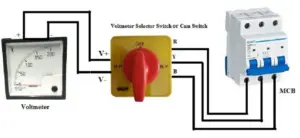
Voltmeter Selector Switch or Cam Switch Wiring
A voltmeter selector switch allows a single voltmeter to measure voltages between different phases, reducing the need for multiple measuring instruments.
Working of a Voltmeter Selector Switch
The circuit consists of:
- Three-phase supply (R, Y, B)
- Cam switch (selector switch)
- Voltmeter
- Miniature Circuit Breaker (MCB)
The R, Y, and B phase terminals are connected to the selector switch through an MCB. The positive and negative terminals of the voltmeter are connected to the V+ and V− terminals of the selector switch.
When the switch knob is rotated:
- RY Position – Displays voltage between R and Y phases.
- YB Position – Displays voltage between Y and B phases.
- BR Position – Displays voltage between B and R phases.
This arrangement allows convenient voltage monitoring in three-phase systems.
Types of Cam Switches
Cam switches are available in various types depending on their intended application.
1. Multistep Cam Switch
Multistep switches connect multiple circuits to a single power source through several selectable positions.
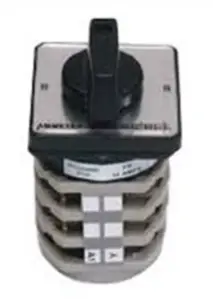
These switches are commonly used in:
- Transformers
- Voltage stabilizers
- Tap-changing applications
- Power control systems
They are available in single-pole, double-pole, and three-pole configurations for single-phase and three-phase systems.
2. Isolator Switch
An isolator switch, also known as an ON/OFF switch, is used to disconnect power from a specific section of an electrical system.
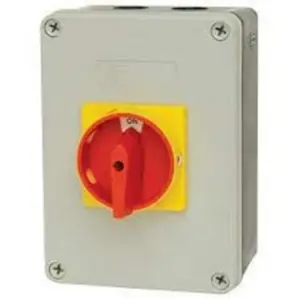
Common applications include:
- Main power isolation
- Motor ON/OFF control
- Instrumentation circuits
- Electrical maintenance systems
3. Voltmeter Selector Switch
Voltmeter selector switches are used in three-phase electrical systems to measure:
- Phase-to-phase voltage
- Phase-to-neutral voltage
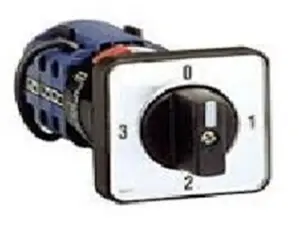
They simplify voltage monitoring by allowing a single voltmeter to perform multiple measurements.
4. Changeover Switch
A changeover switch transfers electrical loads between two power sources.
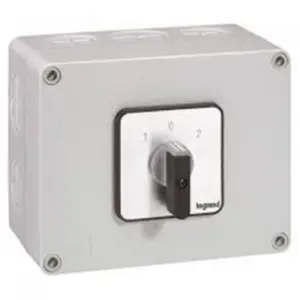
These switches are commonly used for:
- Generator changeover systems
- UPS systems
- Distribution panels
- Backup power arrangements
Changeover switches may be manual, automatic, or remotely operated.
5. Ammeter Selector Switch
An ammeter selector switch is used in three-phase systems to monitor current in different phases using a single ammeter.
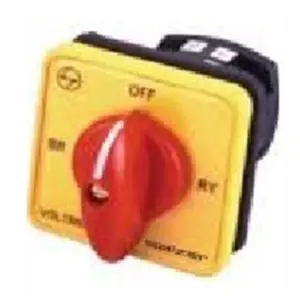
Current transformers (CTs) are installed on each phase, and the selector switch allows the operator to choose which phase current is displayed. This reduces equipment cost and panel space requirements.
6. Control Switch
Control switches provide an alternative to multiple push-button stations and allow operators to control equipment from a single switch.
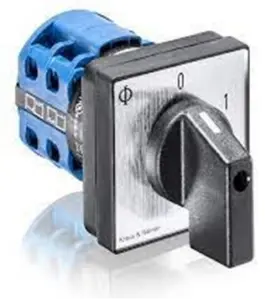
These switches are commonly used in:
- Motor control circuits
- Industrial machinery
- Control panels
- Automation systems
7. Motor Control Switch
Motor control cam switches are specifically designed for controlling electric motors.
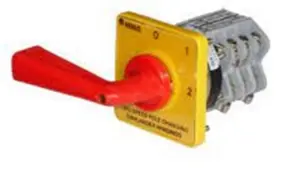
Typical applications include:
- Forward-Reverse motor control
- Star-Delta starters
- Two-speed motor control
- Industrial drive systems
These switches are often used with overload protection devices and contactors.
Advantages of Cam Switches
- Simple and reliable operation.
- Compact design requiring minimal space.
- Cost-effective solution for circuit control.
- Suitable for both AC and DC applications.
- Maintenance-free operation.
- High protection ratings (IP-rated models available).
- Can be mounted on panel doors or inside enclosures.
- Operates effectively in both high and low temperatures.
- Quick and easy installation.
- Long mechanical and electrical lifespan.
- Capable of controlling multiple circuits from a single switch.
Disadvantages of Cam Switches
- Manual operation only; remote control is not possible without additional equipment.
- Not suitable for extremely high current switching applications.
- Does not provide built-in thermal or magnetic protection.
- Requires physical rotation to change positions.
- Frequent switching may lead to mechanical wear over time.
Applications of Cam Switches
Industrial Machinery
- Stamping machines
- Forging presses
- Sheet metal forming machines
- Industrial presses
- Assembly machinery
- Packaging machinery
Material Handling Equipment
- Transport systems
- Mining equipment
- Conveyor systems
Electrical Systems
- Electrical switchboards
- Distribution panels
- Control panels
- Power monitoring systems
Commercial and Industrial Applications
- Air conditioning systems
- Machine tools
- Oil and gas facilities
- Electrical enclosures
- Woodworking machinery
- Food processing and vegetable cutting machines
Conclusion
A Cam Switch is a versatile rotary switching device widely used in electrical and industrial systems for controlling, monitoring, and selecting various circuit functions. With its compact design, reliability, multiple switching configurations, and ease of operation, it remains an essential component in motor control, measurement systems, power distribution, and industrial automation. Its durability and flexibility make it one of the most preferred switching solutions across a broad range of applications.