

Introduction
A Hybrid Stepper Motor is a type of stepper motor that combines the features of both permanent magnet and variable reluctance stepper motors. It offers high torque, excellent positioning accuracy, and superior dynamic performance. Due to its precise motion control capabilities, hybrid stepper motors are widely used in robotics, industrial automation, medical equipment, and consumer electronics.
An electric motor converts electrical power into mechanical power, producing torque and rotational motion. Depending on the application requirements, different types of motors are available. Among them, stepper motors are widely used when precise control of speed and position is required.

A stepper motor is a brushless DC (BLDC) motor that rotates in discrete angular steps. The motor’s rotation angle and speed are controlled electronically through pulse signals supplied by a driver circuit. Each electrical pulse causes the motor shaft to rotate by one step. Stepper motors are generally classified into three types:
- Permanent Magnet Stepper Motor
- Variable Reluctance Stepper Motor
- Hybrid Stepper Motor
What is a Hybrid Stepper Motor?
A Hybrid Stepper Motor combines the operating principles of both permanent magnet and variable reluctance stepper motors. In a hybrid stepper motor, the stator operates similarly to a variable reluctance motor using electromagnetic excitation, while the rotor is axially magnetized like a permanent magnet motor. This combination enables the motor to convert electrical pulse signals into precise angular displacement.
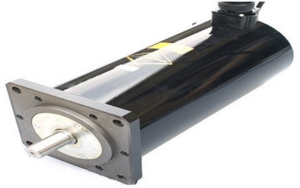
Hybrid Stepper Motor
Compared to other stepper motor types, hybrid stepper motors offer:
- Higher torque output
- Smaller step angles
- Excellent dynamic performance
- Greater positioning accuracy
With the advancement of semiconductor technology, permanent magnet materials, and industrial automation, hybrid stepper motors have found extensive applications in robotics, medical devices, and industrial control systems. Hybrid stepper motors are available in several configurations, including:
- Standard hybrid stepper motors
- Encoder-integrated motors
- IP65-rated motors
- Brake-equipped motors
- Integrated drive and controller motors
- Geared hybrid stepper motors
Hybrid Stepper Motor Construction
The construction of a hybrid stepper motor combines the design characteristics of permanent magnet and variable reluctance stepper motors. These motors are available with various step resolutions, including:
- 0.9°
- 1.8°
- 3.6°
The most common step angle used in industrial applications is 1.8°. Hybrid stepper motors are preferred in industrial systems because they provide excellent static torque, dynamic torque, and reliable operation at high stepping frequencies.
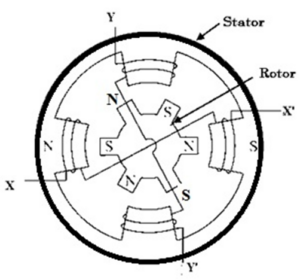
Hybrid Stepper Motor Construction
The two major components of a hybrid stepper motor are:
- Stator
- Rotor
Stator
The stator construction is similar to that of a variable reluctance stepper motor. It contains multiple poles with teeth-like projections designed to interact with the rotor teeth.
Rotor
The rotor consists of two stacks of soft iron laminations attached to the opposite poles of an axially magnetized permanent magnet. The rotor teeth are arranged with a slight angular offset so that they act as alternating north and south poles. This construction enables precise positioning and high torque generation. The interaction between the stator and rotor teeth produces the stepping action that drives the motor.
Working Principle of Hybrid Stepper Motor
The hybrid stepper motor operates using the combined principles of permanent magnet attraction and variable reluctance. Consider a motor with:
- Two phases
- Four stator poles
- A six-tooth rotor
When one stator winding is energized using a DC supply, the corresponding magnetic poles attract the rotor teeth, aligning them with the stator poles. When the excitation shifts to another stator winding, the rotor moves to a new position corresponding to the new magnetic field. By applying electrical pulses sequentially to the stator windings, the rotor rotates step by step in either the clockwise or counterclockwise direction.
The direction of rotation depends on the sequence of excitation applied to the stator windings. One of the important characteristics of a hybrid stepper motor is that it can maintain its position even after the excitation signal is removed due to the magnetic holding force produced by the permanent magnet. The step angle of a simple hybrid stepper motor may be around 30°. However, practical motors use multiple rotor teeth to achieve very high angular resolution.
Features of Hybrid Stepper Motor
- Accurate position control.
- High holding torque.
- Simple pulse-based control.
- Compact design with high torque output.
- Available with electromagnetic brake systems.
- Excellent dynamic response.
- Precise speed control.
Advantages of Hybrid Stepper Motor
- Produces high torque output.
- Provides holding (detent) torque even when de-energized.
- Offers small step angles for precise positioning.
- Provides high efficiency at low speeds.
- Exhibits excellent positional accuracy.
- Delivers superior dynamic performance.
- Supports open-loop control systems.
Disadvantages of Hybrid Stepper Motor
- Higher rotor inertia.
- Greater weight due to the permanent magnet rotor.
- Motor performance depends on magnetic field strength.
- More expensive than other stepper motor types.
- Can generate vibration and noise at certain speeds.
Applications of Hybrid Stepper Motor
- Industrial automation systems.
- Packaging machinery.
- Labeling machines.
- Cutting machines.
- Filling machines.
- Automated production equipment.
- Conveyor systems.
- Lane diverters.
- Elevators.
- Security systems and CCTV cameras.
- Printers and scanners.
- Digital cameras.
- Medical devices.
- Digital dental imaging systems.
- Liquid pumps.
- Respirators.
- Blood analysis equipment.
- Robotics applications.
Conclusion
A hybrid stepper motor combines the advantages of permanent magnet and variable reluctance technologies to provide precise motion control, high torque, and excellent dynamic performance. Due to their high accuracy, reliability, and ease of control, hybrid stepper motors are extensively used in industrial automation, robotics, medical equipment, and consumer electronics. Their ability to achieve precise positioning without requiring complex feedback systems makes them one of the most widely used stepper motor technologies.