

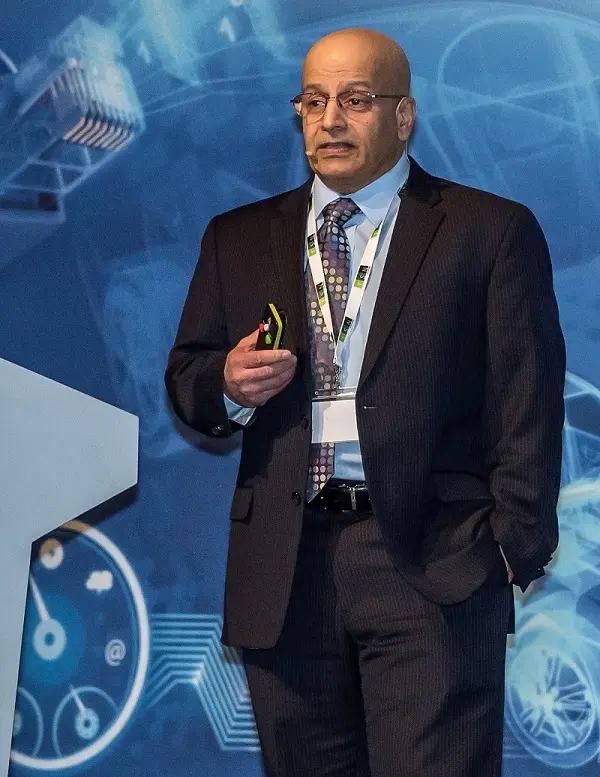
The shift to software-defined vehicles is transforming how automobiles are designed, connected, and updated. Speaking with Vaishali Umredkar, Editorial Director at Semiconductor For You, Shrikant Acharya, Co-founder & CTO, Excelfore, explains how advanced semiconductors, embedded software, AI-driven architectures, and secure connectivity are accelerating the evolution of next-generation mobility.
Q1. The automotive industry is moving from traditional ECU-based distributed architectures towards centralized and zonal architectures. What is driving this transition, and what is the place of semiconductor technology and embedded software in this transformation?
The transition is being driven by a simple economic and engineering reality: as the value in a vehicle shifts from mechanical hardware to software, the old distributed model of one ECU per function no longer scales. A modern car can carry a hundred or more ECUs, each with proprietary firmware and dedicated wiring, adding weight, cost, and complexity while making updates a service-bay exercise rather than a remote one.

Centralized and zonal architectures collapse that sprawl into a small number of high-performance compute (HPC) platforms surrounded by zonal controllers. Peripherals are routed to the nearest zone instead of back to a distant domain controller. The payoff is consolidated hardware, common software workloads across vehicle models, dramatically less cabling, and compute headroom for future features.
Semiconductors and embedded software are the twin engines of this shift. Automotive-grade HPC SoCs — increasingly ARM-based — provide the horsepower to virtualize what used to be dozens of discrete ECUs onto shared hardware. The same architecture enables cloud-based digital twins, where software can be developed and validated before it reaches the vehicle.
On the software side, the monolith is being broken into microservices packaged as containers, orchestrated by lightweight frameworks such as K3s, and delivered through standardized abstraction layers. This makes it possible to write a workload once and deploy it across a heterogeneous fleet. Legacy networks are not eliminated entirely: CAN, for example, is retained for fast wake-up during start-up. Zonal architecture succeeds because it combines a software-defined compute core with a network that can still communicate with existing vehicle systems.
Q2. How is the rise of centralized and zonal compute architecture changing the relationship between semiconductor companies, OEMs, Tier-1 suppliers, and software platform providers?
The relationship has, in many ways, come full circle. When SDVs first gained momentum, many OEMs believed they could bring the entire software and integration stack in-house and disintermediate suppliers. In practice, costs escalated quickly. Orchestrating silicon, middleware, safety, security, and OTA updates across an entire vehicle proved far harder than simply hiring more software engineers.
In the process, OEMs sidelined Tier-1 suppliers that had spent decades mastering systems integration. Now those Tier-1s are needed again to deliver programs on time and at production scale.
A similar shift occurred at the silicon layer. SoC vendors were pulled directly into OEM programs and asked to perform integration work that is not their core competency. They are not structured to sustain that level of customization across dozens of customers.
The healthier equilibrium is a clearer division of labour.
-
- Virtualization and partitioning. Consolidating many ECUs onto one HPC means running mixed-criticality workloads side by side, which demands robust hypervisor partitioning and deterministic communication through time-sensitive networking (TSN).
- Functional safety. Everything running on these platforms must comply with ISO 26262, and demonstrating that compliance across a virtualized, containerized stack is materially harder than certifying a single-purpose ECU.
- OTA at scale. These chips are meant to be updated continuously over their lifetime, which requires a reliable, standards-based OTA pipeline — for example, one built on eSync — capable of orchestrating updates across the whole vehicle, not just the head unit.
- Edge security and cyber-physical threats. A centralized brain controlling safety-critical actuators is a high-value target, so security has to be engineered into the silicon and the software from day one rather than bolted on afterward.
The market is rediscovering that no single player can efficiently own the entire SDV stack end to end.
Q3. Semiconductor companies are investing heavily in automotive SoCs and high-performance computing platforms. What software challenges emerge when these powerful chips are deployed inside vehicles?
Raw silicon performance is necessary, but it is nowhere near sufficient. A powerful chip without an equally capable software framework is effectively inert. NVIDIA’s dominance depends as much on CUDA as on GPUs, and Google’s TPUs depend on XLA and JAX. Automotive SoCs face the same reality.
Several software challenges such as virtualization and partitioning, functional safety, OTA updates at scale,Edge security and cyber-physical threats emerge when these chips are deployed in vehicles.
A centralized compute platform that controls safety-critical actuators becomes a high-value target. Security must therefore be engineered into both the silicon and the software from the beginning, rather than added later.
The broader point is that automotive computing is no longer just a hardware problem. The software ecosystem around the chip determines whether that silicon can be used safely, securely, and repeatedly across vehicle generations.
Q4. With centralized architectures reducing ECU complexity, how will automotive networks evolve? What role will Automotive Ethernet, Ethernet TSN, zonal controllers, and AI play?
The clearest requirement is for a network that can scale up and down in bandwidth without forcing a redesign every time the compute platform grows. Automotive Ethernet fits that requirement better than any alternative.
It becomes the backbone that allows zonal controllers to aggregate local peripherals and connect them to a central HPC platform over a common physical layer. TSN provides the determinism required for safety-critical and control-critical traffic.
The pacing item is the physical layer. High-speed switching requires PHYs that can keep up. Companies such as Eternovia are already bringing 20 Gbit PHYs to market. From there, bandwidth is expected to scale toward 100–200 Gbit as more vehicle data is routed back to centralized compute.
This growing data demand is being driven largely by AI. Edge intelligence inside the vehicle requires richer sensor data for perception, predictive maintenance, driver assistance, personalization, and fleet analytics.
As a result, the vehicle network stops being a collection of isolated buses and becomes a single, high-bandwidth, deterministic data fabric. That fabric must scale with the vehicle’s compute requirements and its AI ambitions.
Q5. India is emerging as an important hub for semiconductor design, automotive software, and EV innovation. What opportunities exist for Indian companies in the SDV ecosystem?
India is having a genuine automotive moment, and the opportunity is larger than EV headline numbers alone suggest. For two decades, India has been a global engineering delivery center for automotive software and connected-vehicle programs. The capability already exists; the opportunity now is to apply it to products designed for India and for export markets.
The same talent pool that built platforms for global manufacturers can help author India’s own SDVs. That aligns with the spirit of Atmanirbhar Bharat: products built for India, with export potential, using software that scales without a proportional increase in cost.
India’s market structure is also different from that of Western SDV markets. Two-wheelers account for the majority of EV sales, with three-wheelers and commercial fleets also playing a major role. India is electrifying around high-volume, cost-sensitive, heavily utilized vehicles rather than primarily around premium passenger cars.
That changes what software must deliver. The winning approach is deployment based on usability rather than feature count, with features-on-demand priced for the market. Instead of expensive bundled packages, India may require many small features delivered at very low price points.
Q6. Will the adoption be more noticeable in high-end vehicles?
High-end vehicles will play an important strategic role. They can serve as the first deployment platform for advanced capabilities, validate those features, and support export markets before costs come down for mass adoption.
Indian companies can compete across the full stack -semiconductor and SoC design
- Cost-disciplined automotive software
- Edge AI capabilities
- Predictive maintenance and fleet uptime solutions
- Secure OTA infrastructure
Q7. What are other key elements that come into play here?
Edge AI is particularly important because vehicles can learn their own operating signatures and detect anomalies before they become failures — a major advantage for commercial fleets where uptime is critical.
Secure, standards-based OTA infrastructure is equally important. Frameworks such as the eSync Alliance specification provide a scalable alternative to proprietary, single-vendor update pipelines.
The engineering talent, market momentum, and national impetus are already in place. India’s opportunity is not simply to participate in the global SDV transition, but to help define a model for frugal, scalable, high-volume mobility — and then export that model globally.