
Introduction
A processor is an electronic chip or logic circuit that controls and performs processing operations by responding to input signals and programmed instructions. It is one of the most important components used in electronic devices such as mobile phones, embedded systems, laptops, computers, and many other digital systems.
The two main components of a processor are the Arithmetic Logic Unit (ALU) and the Control Unit. Depending on the application, different types of processors are available, including microprocessors, microcontrollers, embedded processors, and digital signal processors. Among these processor types, a Digital Signal Processor (DSP) is specially designed to process digital signals efficiently and perform complex mathematical operations at high speed.

What is a Digital Signal Processor?
A Digital Signal Processor (DSP) is a specialised type of microprocessor designed to process digital signals quickly and efficiently. DSPs are generally implemented using integrated circuits and are optimised for performing mathematical operations such as addition, subtraction, multiplication, and division.
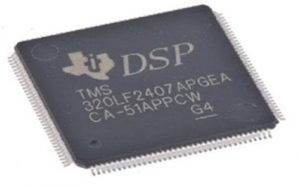
Digital signal processors are widely used in consumer electronics, including mobile phones, HDTV products, disc drives, and telecommunications equipment. They are also used in various industrial and advanced applications, such as digital image processing, audio signal processing, speech recognition systems, sonar, radar, and biomedical engineering.
How Does a Digital Signal Processor Work?
A digital signal processor works by converting and mathematically processing real-world signals such as audio, voice, temperature, images, and video. The DSP performs mathematical operations at high speed to analyse, modify, filter, compress, or improve the digital signal.
The main components of a digital signal processor include:
- Input/Output Unit
- Computation Engine
- Program Memory
- Data Memory
Program Memory: It stores the instructions or programs required to process the data.
Data Memory: It stores the data that needs to be processed.
Computation Engine: It performs mathematical operations and accesses data from data memory and instructions from program memory.
Input/Output Unit: It provides communication between the DSP and external devices.
Digital Signal Processor Block Diagram
The basic block diagram of a digital signal processor is shown below.
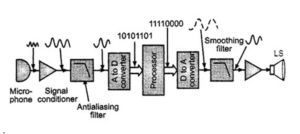
In a typical DSP system, a microphone may be used as an input transducer to convert a sound signal into an electrical signal. An operational amplifier (op-amp) is then used to condition the analogue electrical signal generated by the microphone. A Low-Pass Filter (LPF) is used before the Analogue-to-Digital Converter (ADC) as an anti-aliasing filter. This filter limits the bandwidth of the input signal and removes unwanted high-frequency components.
The ADC converts the analogue signal into a digital or binary data stream. The DSP then processes this digital data according to the required application. The processed digital signal is passed to a Digital-to-Analogue Converter (DAC), which converts it back into an analogue signal. Another low-pass filter, known as a smoothing filter, removes unwanted high-frequency components from the output. Finally, an output transducer such as a speaker converts the processed electrical signal into sound. Other output devices can also be used depending on the application.
Features of Digital Signal Processors
The primary purpose of a digital signal processor is to perform repetitive and computationally intensive tasks efficiently.
- High-speed mathematical processing.
- Ability to transfer large volumes of data quickly.
- Specialised instruction sets for improved processing efficiency.
- Multiple-access memory architecture.
- Fast multiply-accumulate operations.
- Data pipelining for improved processor performance.
- Optimised architecture for signal processing applications.
Pipelining improves processor performance by allowing multiple operations to be processed in different stages simultaneously. However, advanced pipelining can also make programming more complex.
Characteristics of Digital Signal Processors
- DSPs are designed to achieve high performance in signal-processing applications.
- Program memory and data memory are generally separate.
- They use specialised addressing modes, such as modulo addressing and bit-reversed addressing.
- Some DSP systems can work with Direct Memory Access (DMA) capabilities.
- They can efficiently process multiple data sets.
- Special hardware is available for efficient looping operations.
- Multiple multipliers and accumulators can operate in parallel.
- Some DSPs support floating-point arithmetic.
- Fixed-point arithmetic is commonly used to perform calculations at high speed.
Digital Signal Processor Architecture
The major architectures used in digital signal processors include:
- Von Neumann Architecture
- Harvard Architecture
- Super Harvard Architecture
1. Von Neumann Architecture
The main components of the Von Neumann architecture are a single memory and a single bus. The same memory and bus are used to transfer both program instructions and data to and from the Central Processing Unit (CPU).
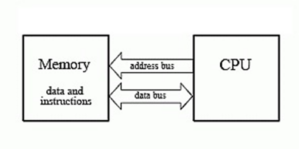
Because instructions and data share the same bus, operations must generally be performed sequentially. This architecture is suitable for systems where operations can be executed serially. Von Neumann architecture is widely used in conventional computer systems, although other architectures are often preferred for high-speed computing applications.
2. Harvard Architecture
Harvard architecture was developed based on computer architecture research carried out at Harvard University. This architecture uses separate memory and separate buses for program instructions and data.
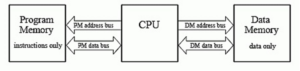
Because the program and data buses operate independently, instructions and data can be accessed simultaneously. This improves processing speed compared with a single-bus architecture. Many DSPs use this type of dual-bus architecture to achieve faster data processing.
3. Super Harvard Architecture
Super Harvard Architecture is an enhanced version of the Harvard architecture designed to improve DSP performance and throughput.
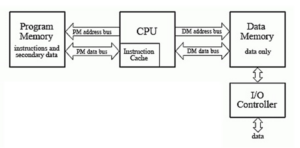
The term SHARC, which stands for Super Harvard Architecture, is associated with a family of DSPs developed by Analog Devices. This architecture includes additional features to improve throughput. Important features include an instruction cache and an input/output controller.
Types of Digital Signal Processors
Digital signal processors are mainly classified into two types:
- Fixed-Point Digital Signal Processors
- Floating-Point Digital Signal Processors
1. Fixed-Point Digital Signal Processor
In a fixed-point digital signal processor, numerical values are represented with a fixed position for the fractional point. A fixed-point number can commonly be represented using at least 16 bits, although other word lengths are also possible. The fractional point position of both the operands and the operation result is assumed to be fixed.
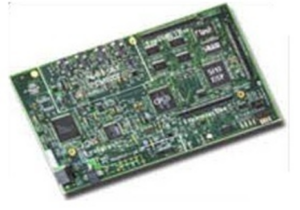
Fixed-point processors are widely used in embedded applications because they consume relatively low power and are generally less expensive. Examples of fixed-point DSP families include:
- TI TMS320C54x
- ADI Blackfin BF53x
- TI TMS320C55x
- Motorola MSC810x
- TI TMS320C64x
2. Floating-Point Digital Signal Processor
Floating-point digital signal processors generally represent each value using at least 32 bits. Floating-point representation allows a wide range of numerical values to be processed efficiently. Floating-point DSPs can process both fixed-point and floating-point numerical values and are useful in applications that require high precision and a wide dynamic range.
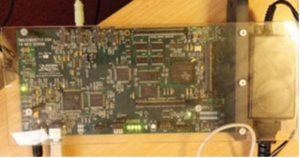
Floating-point DSP programming is generally easier than fixed-point DSP programming. However, floating-point processors are typically more expensive and consume more power. Examples of floating-point DSPs include:
- TI TMS320C67x
- ADI ADSP-2116x
- ADI ADSP-2126x
Digital Signal Processor Instruction Sets
Digital signal processors use specialised instruction sets to perform high-speed control, multiprocessing, and numerically intensive signal-processing operations. A typical DSP instruction set may include the following categories:
- Accumulator, arithmetic, and logic instructions.
- Auxiliary register and data page pointer instructions.
- TREG, PREG, and multiplication instructions.
- Branch instructions.
- Control instructions.
- Input/output and memory operation instructions.
DSP instructions may be organised alphabetically or by function. The instruction set generally specifies how many words an instruction occupies in program memory and how many clock cycles are required for execution.
Advantages of Digital Signal Processors
- Low overall noise.
- Easy error detection and correction.
- Simple data storage.
- Digital signals can be easily encrypted.
- Large amounts of data can be transmitted and processed.
- Programs can be easily modified by changing commands or code.
- DSP systems can operate over a wide range of frequencies.
- Multiple DSP stages can be cascaded without significant loading issues.
- DSP operations can be modified by changing the program.
- Complex signal-processing algorithms can be implemented efficiently.
- DSPs are lightweight and compact.
- DSP systems can be upgraded through software.
Disadvantages of Digital Signal Processors
- Digital communication may require higher bandwidth than analogue communication for data transmission.
- Many digital signal processors can be relatively expensive.
- DSP system complexity can increase because of the additional components required.
- DSPs use several transistors and may consume more power than analogue signal-processing systems.
- Different DSPs have different hardware architectures and instruction sets.
- Highly skilled engineers may be required to program and optimise DSP devices.
Applications of Digital Signal Processors
Digital signal processors are used in a wide range of consumer, industrial, scientific, and communication applications.
- Data compression.
- Digital image processing.
- Image compression.
- Audio processing and audio coding.
- Video processing and video coding.
- Speech recognition and speech processing.
- Signal processing for control systems.
- Telecommunications.
- Radar systems.
- Sonar systems.
- Sensor array processing.
- Seismology.
- Biomedical engineering.
- Statistical signal processing.
- Spectral density estimation.
Conclusion
A Digital Signal Processor (DSP) is a specialised microprocessor designed to perform complex mathematical and signal-processing operations at high speed. Its ability to process digital signals efficiently makes it an essential component in modern electronic and communication systems.
With specialised architectures, high-speed computation, dedicated instruction sets, and efficient memory systems, DSPs are widely used in applications such as audio processing, image processing, telecommunications, radar, sonar, biomedical systems, and control systems. Depending on the application requirements, designers can choose between fixed-point and floating-point DSPs to achieve the required balance between performance, precision, power consumption, and cost.