
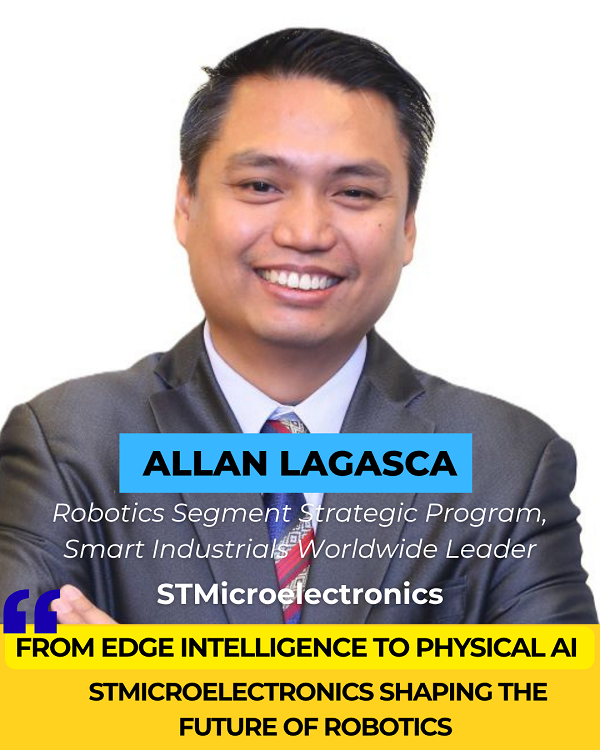
Robotics is rapidly evolving from automation pilots to intelligent Physical AI systems. In this exclusive conversation, Vaishali Umredkar, Editor, Semiconductor For You, speaks with Allan Lagasca, Robotics Segment Strategic Program, Smart Industrials Worldwide Leader, STMicroelectronics, about the semiconductor innovations shaping next-generation robotics—from edge AI and advanced sensing to efficient power, motion control, safety and distributed intelligence.

Q1. How do you see the robotics industry evolving over the next 3–5 years, and what role will specialized semiconductor technologies play in driving commercial adoption across sectors like industrial automation, spatial vision, and autonomous fleets?
Allan Lagasca:
Over the next 3–5 years, robotics, especially humanoid robotics, will move from automation pilots to scalable Physical AI systems across factories, warehouses, healthcare environments, infrastructure, and autonomous fleets. The decisive shift is intelligence moving into the machine itself through distributed sensing, edge processing, motion control, and power management.
Specialized semiconductors will determine how fast this market scales because robots must perceive, decide, and act with low latency, energy efficiency, functional safety, and cybersecurity. ST’s Robotics segment strategy is built around this system view. By combining STM32 and STM32N6 edge processing, MEMS and imaging, ToF sensing, motor control, connectivity, power silicon, and safety/security technologies, ST helps customers turn AI models into dependable machines that can operate safely and commercially in the physical world.
Q2. As robotics applications shift toward AI-driven autonomy, what semiconductor breakthroughs—such as low-power NPUs, spatial vision chips, MEMS, LiDAR, and sensor fusion—are most critical for real-time decision-making at the edge?
Allan Lagasca:
For AI-driven robotics, the most important semiconductor breakthroughs bring perception, inference, and control closer to the point of action. Physical AI requires robots to understand space, motion, touch, force, and intent in real time, making low-power edge AI processors, spatial vision, MEMS, ToF sensing, current sensing, and sensor fusion essential.
ST connects this perception-to-action loop with image and ToF sensors, MEMS for motion and vibration, STM32 and STM32MP for real-time control, and STM32N6 with embedded neural acceleration for local inference. This edge architecture reduces cloud dependence, improves response time and bandwidth efficiency, and enables safer autonomy. Combined with secure processing, industrial connectivity, and functional-safety software, it gives developers a practical path from intelligent sensing to commercial robotic deployment.
Q3. Energy efficiency, latency, and thermal dissipation remain major hurdles in physical systems. How are modern chip architectures and power devices such as GaN and SiC solving these bottlenecks to make advanced and humanoid robots commercially viable?
Allan Lagasca:
The hardware bottlenecks in humanoid and advanced robots are energy, heat, latency, and integration density. Every joint, hand, sensing node, and power domain must convert electrical energy into precise physical motion without wasting space, battery life, or thermal margin.
ST addresses this with real-time STM32 control, STSPIN and STDRIVE motor-control technologies, current sensing, protection, power management, GaN, and SiC to create compact, efficient actuator and power modules. GaN is especially relevant for high-density joints and hands where fast switching, compact form factor, and thermal efficiency matter, while SiC supports higher-power conversion and resilient energy delivery.
By linking efficient power with deterministic control, sensing, connectivity, functional safety, and cybersecurity, ST helps customers move from prototypes to scalable humanoid platforms with longer runtime, faster response, and trusted operation.
Q4. Looking ahead over the next decade, what emerging semiconductor trend or architectural shift do you believe will have the single biggest impact on the robotics industry?
Allan Lagasca:
The biggest architectural shift will be from centralized robot intelligence to distributed, trusted intelligence embedded throughout the machine. Next-generation robots will not depend on one powerful brain alone; they will use coordinated semiconductor nodes across perception, joints, hands, power systems, communications, and safety layers.
This is essential for Physical AI because machines must react locally, safely, and efficiently while remaining connected to higher-level AI and fleet-management systems. For ST, this aligns directly with our Robotics Segment strategy and is strongly positioned for this transition with STM32 and STM32N6 edge intelligence, MEMS and imaging sensors, ToF, motor-control ICs, GaN and SiC power technologies, connectivity, STM32Trust, STSAFE, and functional-safety software.
Over the next decade, this convergence of edge processors, sensing, and power silicon will define which robotics platforms can scale commercially across industrial, service, medical, humanoid, and autonomous fleet applications.