

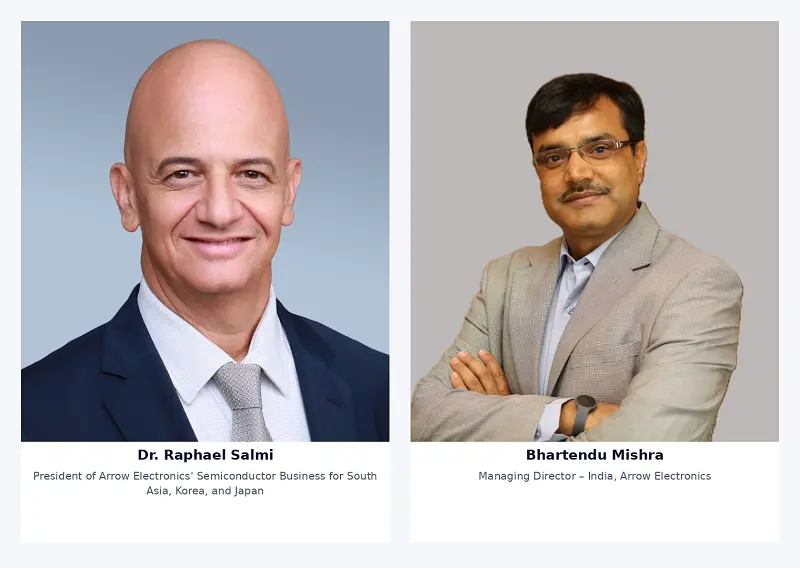
In an exclusive interview, Vaishali, Editor of Semiconductor For You, speaks with Dr. Raphael Salmi, President of Arrow Electronics’ Semiconductor Business for South Asia, Korea, and Japan, and Bhartendu Mishra, Managing Director – India, Arrow Electronics. They discuss India’s rapid rise as a global electronics hub, the evolution of component distribution, design challenges, and Arrow’s strategic vision for 2030.
Q1. India is racing to become a global electronics manufacturing powerhouse. In the next 5–7 years, how do you see the role of distributors like Arrow evolving from component suppliers to strategic innovation partners for Indian OEMs and start-ups?
Dr. Raphael Salmi: India is undergoing a remarkable transformation. According to NITI Aayog, the country’s electronics manufacturing industry has the potential to reach US$500 billion by FY2030, reflecting India’s growing importance in the global technology value chain.
Some of the most significant trends we are watching are the convergence of AI, connectivity, electrification, and automation. What is changing is not just the technology itself, but the growing level of ecosystem collaboration required to bring innovation to market quickly and at scale.
As a result, distributors are evolving well beyond traditional component fulfillment. Customers increasingly need support across the entire innovation journey, from technology selection and system architecture through engineering, sourcing, manufacturing readiness, and lifecycle management.
For Indian OEMs and start-ups, success will depend on how effectively they connect engineering talent, manufacturing capabilities, and global technology ecosystems. Whether it is AI, connectivity, electrification, industrial automation, or semiconductors, the common theme is ecosystem collaboration. Arrow’s role is to connect technology, engineering expertise, supply-chain intelligence, and global market access, helping customers accelerate the journey from concept to commercialization and transform innovation into real-world impact.
Q2. With India’s semiconductor and electronics design ecosystem growing rapidly under schemes like ISM and DLI, what unique challenges do you anticipate for design engineers in India?
Dr. Raphael Salmi: India’s role is expanding beyond technology adoption to technology creation. Supported by a vibrant innovation ecosystem, deep engineering talent, and strategic investments in semiconductors, AI, and digital infrastructure, the country is becoming an increasingly important contributor to global technology innovation.
As this ecosystem matures, design engineers are being asked to solve increasingly complex challenges. Modern products are no longer defined by a single technology domain. They typically integrate AI, connectivity, embedded software, sensing, power management, and security into highly interconnected systems.
As a result, the challenge is no longer simply selecting components or designing a product. Engineers must manage system-level complexity, accelerate time-to-market, mitigate supply chain risks, and plan for long-term product lifecycle support from the earliest stages of development.
This is where trusted ecosystem partners become increasingly important. Arrow helps customers bridge these capability gaps through engineering expertise, development platforms, reference designs, software tools, and supply chain intelligence. By supporting customers from concept and architecture through validation, manufacturing, and commercialization, we help them innovate faster and bring differentiated products to market more efficiently.
Q3. Physical Intelligence, Edge AI, and software-defined systems are reshaping industries. How is Arrow positioning itself in India?
Bhartendu Mishra: Physical Intelligence, Edge AI, and software-defined systems are fundamentally transforming how products are designed across mobility, industrial automation, energy, and connected infrastructure. As intelligence increasingly moves to the edge, customers need solutions that seamlessly combine compute, software, connectivity, sensing, and power technologies.
This shift is also changing customer expectations. Organizations are no longer looking for individual components alone. They need integrated platforms and engineering support that can help reduce development complexity, accelerate innovation, and scale products from concept to deployment.
Arrow is well positioned to support this transformation through our broad technology portfolio, engineering expertise, development platforms, reference designs, software tools, and global supply chain capabilities. We help customers move more quickly from concept to proof of concept, and from prototype to production-ready systems. Recent demonstrations at electronica India showcased how these capabilities come together in real-world applications across AI-enabled edge computing, industrial automation, connectivity, intelligent sensing, and advanced power architectures. By bringing together leading technologies and ecosystem partners, Arrow helps customers reduce development complexity, accelerate the journey from concept and prototyping to commercialization, shorten time-to-market, and transform emerging technologies into real-world business impact.
“India’s role is expanding beyond technology adoption to technology creation.”
— Dr. Raphael Salmi
President, Semiconductor Business (South Asia, Korea & Japan), Arrow Electronics
“The future of innovation depends on how effectively we connect local ideas to global market opportunities.”
— Bhartendu Mishra
Managing Director – India, Arrow Electronics
Q4. Looking ahead to 2030, India aims to significantly expand electronics exports and local value addition. What bold bets is Arrow making?
Dr. Raphael Salmi: India’s goal of expanding its electronics manufacturing capabilities and increasing local value addition by 2030 reflects a significant opportunity for the broader technology ecosystem. Beyond manufacturing growth, it highlights the increasing importance of engineering, supply chain capabilities, and innovation in supporting the next phase of industry development.
We see strong momentum across semiconductor design, electronics manufacturing, and emerging technologies such as AI, electrification, industrial automation, and intelligent connectivity. As these sectors continue to evolve, customers are looking for ways to accelerate product development, reduce complexity, and bring innovations to market more efficiently.
Arrow’s commitment is to help customers succeed in this rapidly evolving environment. By combining leading technologies, engineering expertise, development tools, and global supply chain capabilities, we help customers accelerate innovation adoption, strengthen resilience, and move more quickly from concept to commercialization.
We believe India’s growing role in the global technology ecosystem creates significant opportunities for innovators, manufacturers, and technology providers alike. Our focus is on enabling customer success by helping connect ideas, technologies, and ecosystems that can transform innovation into real-world impact.
Q5. What will separate the winners from the rest in the next decade of EV and smart mobility innovation?
Dr. Raphael Salmi: The future of mobility will be shaped by the convergence of electrification, connectivity, software, automation, and AI.
The companies most likely to succeed will not necessarily be those with access to individual technologies, but those that can effectively integrate multiple technology domains into scalable solutions. Battery management, power electronics, connectivity, vehicle intelligence, sensing, and software will increasingly need to work together as a unified system.
Another key differentiator will be ecosystem collaboration. Future mobility innovation requires close cooperation across semiconductor suppliers, OEMs, software developers, manufacturing partners, and supply chain organizations.
Those that are able to innovate rapidly while maintaining reliability, regulatory compliance, scalability, and supply chain resilience will be best positioned to capitalize on emerging opportunities. Arrow helps enable that success by bringing together leading technologies, engineering expertise, development tools, and supply chain capabilities, helping customers navigate complexity, accelerate innovation, and bring differentiated mobility solutions to market more efficiently.
Q6. How is Arrow investing in the next generation of Indian engineers?
Bhartendu Mishra: Engineers and innovators need access to development tools, technical expertise, validation resources, manufacturing readiness support, and pathways to market. The future of innovation depends on how effectively those elements are connected.
Arrow supports this ecosystem by helping engineers and innovators move from idea to architecture, from proof of concept to production, and from local innovation to global market opportunities. Through initiatives such as our collaboration with STPI’s IoT OpenLab in Bengaluru and regional innovation programs, we provide access to engineering expertise, technical training, and broader technology ecosystems.
In addition, Arrow’s digital engineering resources help accelerate development and innovation. Through Digital Test Drive platforms and reference design solutions available on Arrow.com, engineers and innovators can explore and evaluate technologies, gain hands-on experience with real-world applications, and accelerate the journey from concept to implementation. By combining these resources with our engineering support and ecosystem partnerships, Arrow helps equip the next generation of Indian engineers and innovators with the tools, knowledge, and capabilities needed to transform ideas into commercially successful products.