
A resonator is often called the “heart of a clock” because it determines the precise frequency of an oscillator system, which in turn provides the timing reference for an electronic system. Although a resonator defines the frequency of the timing reference, since it is a passive device it does not create the clock signal itself. A resonator is a mechanical device that vibrates at a specific resonant frequency. An oscillator drive circuit converts this mechanical behavior into an electrical clock signal, allowing that frequency to be used as a timing reference within an electronic system.

The resonator’s frequency is determined by its physical properties. When paired with an oscillator drive circuit, an oscillator system is formed which reinforces this natural frequency to produce a stable output clock. Depending on its complexity, the oscillator can help minimize frequency variations caused by temperature, aging and other environmental factors, improving long-term stability. In some scenarios the oscillator system can be disciplined to an external reference, enabling precise synchronization with other systems. In this configuration, the resonator’s vibration is sustained to form a well-defined output frequency that underpins accurate timing in watches, smartphones and network equipment, supporting performance, reliability and data integrity.
How Do Different Types of Resonators Compare?
While other resonator technologies exist, this comparison focuses on quartz, MEMS and atomic resonators because they represent three key approaches to generating highly stable frequency references across a wide range of timing applications. Resonators use different physical properties to establish a stable frequency reference, resulting in distinct performance characteristics. The chart below highlights the key tradeoffs among the three technologies:
Resonator Comparison
| Quartz Crystal Resonator | Silicon MEMS Resonator | Atomic Resonator | |
|---|---|---|---|
| Overview | Thin slices of quartz crystal, effective for high-quality factor applications, prone to mechanical stress. Common in traditional crystal resonator-based oscillators. | Microscopic single crystal silicon structures made with semiconductor processes. Smaller and lighter than quartz and ruggedized for harsh environments. | Specialized, chip-integrated devices that use atomic energy transitions as a frequency reference. |
| Frequency Stability (Long-Term) | Moderate; affected by environmental factors; unpredictable aging | Consistent due to silicon processing; superior aging | Extremely high; defined by atomic physics (primary frequency standards) |
| Frequency Stability (Short-Term) | Good; commonly used as a “flywheel” oscillator | Very good; exceptionally stable under vibration and extended temperature ranges | Good; typically paired with a high-quality “flywheel” oscillator |
| Aging | Prone to drift from material stress or contamination during the hermetic sealing at the packaging stage | Low aging due to hermetic encapsulation during silicon processing | Near-zero; atomic transitions do not age traditionally |
| Size | Small to moderate; constrained by bulk material and size overhead from the ceramic package | Extremely small; up to 1000X and at least 7X smaller/lighter than the smallest comparable quartz | Large (conventional); chip-scale atomic clocks (CSACs) are compact but larger than quartz or MEMS |
| Power Consumption | Low; simple drive circuitry | Low; minor/travel tweaks to the same simple drive circuit used with quartz can deliver up to ~50% lower power consumption with comparable system specs | High; heaters and supporting electronics needed |
| Vibration and Shock Resilience | Sensitive; frequency shifts under shock/vibration | Robust due to low mass and stiffness | Generally robust at chip-scale; traditional atomic clocks vary |
| Cost | Smaller devices tend to be more expensive and fragile in high-volume contexts | Smaller devices tend to be less expensive and more robust in high-volume contexts | Very high (atomic physics hardware and manufacturing complexity) |
Beyond differences in performance, resonators can contribute to system reliability, energy efficiency and simplified circuit design. Resonators can help withstand shock and vibration, support extended battery life and, when paired with an oscillator die in a MEMS oscillator IC, can reduce the need for external components. These characteristics help engineers balance stability requirements, minimize layout complexity and save board space across a wide range of applications.
Key Applications
Electronic systems rely on resonators to maintain consistent timing and synchronization. Common application areas include:
- Mobile and IoT: Sensors, wearables and smartphones powering short-range data protocols and edge architectures.
- Consumer Electronics: Smart home systems, audio/video equipment, entertainment and AR/VR.
- Communications and Enterprise: Base stations, small cells, routers and wireless infrastructure supporting Wi-Fi, Bluetooth and cellular networks.
- Computing and Datacenters: Microprocessors, memory modules, PCIe buses and high-speed data links in servers and datacenters.
- Industrial: Factory automation, robotics and process control equipment.
- Automotive: Advanced Driver-Assistance Systems (ADAS), infotainment and in-vehicle networking.
- Aerospace and Defense: Avionics, radar and secure communication platforms.
- Medical Devices: Patient and blood pressure monitors, hearing aids, fitness trackers and defibrillators.
What Can Go Wrong?
Resonators can face a range of challenges. Factors that affect resonator accuracy and reliability include:
- Mechanical Stress: Resonators can experience frequency shifts or performance degradation when exposed to shock and vibration (high g-forces), which can elevate phase noise in sensitive applications, resulting in reliability issues or system failure.
- Temperature Drift: Rapid or extreme temperature changes can cause the resonant frequency to deviate from its target value, leading to timing errors and increased clock jitter.
- Aging: Over time, gradual physical or environmental changes can alter a resonator’s characteristics, requiring calibration or eventual replacement. Contaminants trapped inside a ceramic package can break loose and cause frequency shifts, leading to degraded system performance and operational failure.
- Manufacturing Defects: Improper sealing, impurities or other production issues can allow moisture or contaminants to enter, causing long-term instability or failure.
- Electrical Mismatch: Incorrect electrical loading or mismatching with the oscillator IC can inhibit startup or introduce large errors.
Why Use MEMS Solutions for Resonators
MEMS timing solutions address resonator weaknesses through their architecture, manufacturing, packaging and compensation techniques:
- Material Selection: Silicon MEMS offers high mechanical resilience and low failure rates, forming a reliable foundation for SiTime MEMS oscillator designs.
- Temperature Compensation: Built-in sensors and control circuits (TCXOs) adjust the output to maintain accuracy across extreme temperature changes, supporting low jitter clock performance.
- EpiSeal™ Packaging: Wafer-level vacuum encapsulation creates a hermetic environment that prevents contamination, enables superior aging and minimizes long-term frequency drift, preserving timing integrity throughout the product lifecycle.
- Oscillator Architecture: Options for combining the resonator and oscillator IC in a single unit can eliminate external component mismatches and ensure reliable startup, simplifying architectures paired with clock buffer or timing devices.
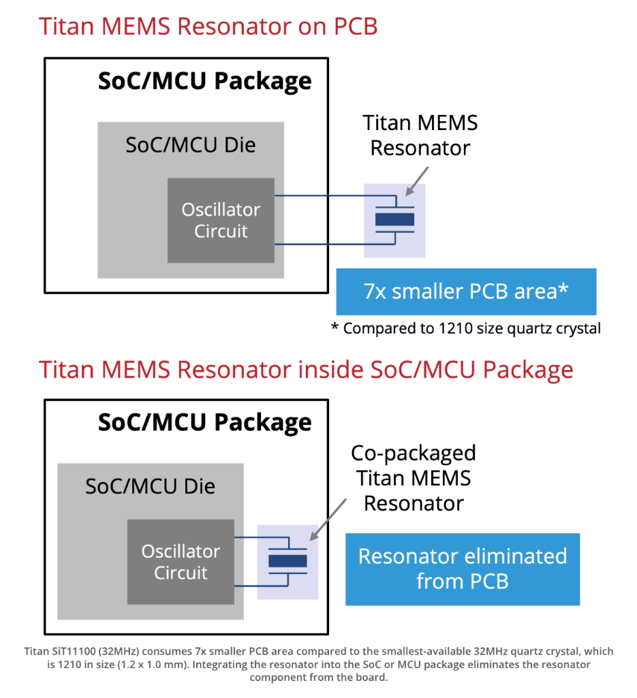
- Miniaturization and Integration: Modern MEMS resonators enable compact timing solutions for space-constrained applications such as IoT and mobile devices, while providing the frequency stability required by these systems. TitanTM standalone resonators can be integrated directly into system-on chip (SoC) or MCU packages, eliminating the need for a discrete component on the board altogether.