
By Sean Walker, EMRADAR
Testing Whether an Ecosystem Is Actually Forming
On 23 September 2026, EMRADAR classified India’s semiconductor ecosystem as FORMING.

The classification was not based on the announcement of another semiconductor fabrication plant.
Instead, EMRADAR detected something broader: developments across semiconductor fabrication, assembly and testing, equipment, materials, suppliers, research and workforce capacity were beginning to appear together.
That distinction matters.
A new factory is an investment event. A functioning semiconductor ecosystem requires much more around it: manufacturing equipment, chemicals and gases, substrates, packaging and testing, qualified suppliers, technical workers, research capability and customers capable of sustaining the resulting capacity.
EMRADAR’s question was therefore not simply, “Is India investing in semiconductors?”
That was already clear.
The question was:
Is there enough independent evidence to suggest that the industrial system surrounding semiconductor manufacturing is beginning to form?
THE SIGNALS EMRADAR CONNECTED
Several developments identified during the scan were individually significant.
Together, they suggested something different.
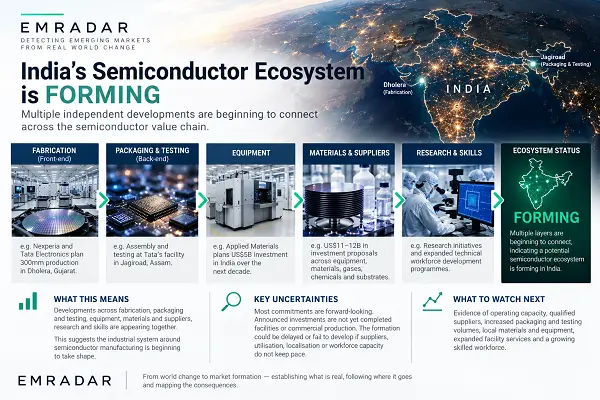
Nexperia and Tata Electronics announced a partnership spanning both ends of semiconductor manufacturing in India. Plans include production of Nexperia power semiconductor products at Tata Electronics’ forthcoming 300mm fab in Dholera, Gujarat, alongside assembly and testing at Tata’s facility in Jagiroad, Assam.
That connects front-end fabrication with back-end packaging and testing rather than representing an isolated manufacturing announcement.
Applied Materials separately announced plans to invest US$5 billion in India over the next decade.
Its plans extend beyond a conventional corporate expansion. They include semiconductor research, workforce development and an ambition to expand India-based supply-chain capacity tenfold by 2035.
At the same time, India’s Semicon 2.0 programme was attracting approximately US$11–12 billion in investment proposals covering semiconductor equipment, materials, gases, chemicals and substrates.
These are precisely the less-visible industries required around semiconductor fabs and packaging plants.
Government and industry initiatives were also expanding the skills side of the system, including technician and engineering development.
EMRADAR treated these developments as separate signals first.
Only after establishing that they affected different but complementary parts of the same production system did the larger pattern become relevant.
WHY EMRADAR CALLED IT FORMING
EMRADAR uses evidence states deliberately.
FORMING does not mean established.
It means enough independent pieces are beginning to connect that a potential market formation deserves continued observation.
India now has evidence appearing across multiple layers:
Fabrication → packaging and testing → equipment → materials → suppliers → research → skills.
That is materially different from seeing several announcements concentrated in only one layer.
A semiconductor fab creates requirements outside the fab itself. Equipment must be installed and maintained. Production requires specialty materials, chemicals and gases. Chips require assembly and testing. Suppliers need qualification. Engineers and technicians need training.
As more of those requirements begin attracting capital and industrial activity at the same time, the economic consequence can spread beyond the original factories.
That expanding consequence is what EMRADAR was detecting.
BUT ANNOUNCEMENTS ARE NOT FACTORIES
This is also where EMRADAR deliberately limits its conclusion.
Much of the evidence remains forward-looking.
Applied Materials’ US$5 billion programme extends over a decade. Its tenfold Indian supply-chain expansion is a target rather than tenfold capacity operating today.
Likewise, the US$11–12 billion associated with Semicon 2.0 represents investment proposals expected to develop over coming years. Proposals are not completed facilities, qualified suppliers or commercial production.
India also has not yet demonstrated every part of a mature semiconductor manufacturing ecosystem at scale.
For that reason, EMRADAR did not classify the formation as established or confirmed.
It classified it as FORMING.
The distinction prevents future commitments from quietly becoming present-day facts.
WHAT WOULD STRENGTHEN THE SIGNAL?
A genuine formation should produce additional evidence.
EMRADAR would expect to see some of the current commitments turn into operating capability: equipment and materials facilities being completed, suppliers becoming qualified, packaging and testing volumes increasing, specialist maintenance and facility systems expanding, trained workers entering production environments and domestic suppliers winning repeat semiconductor business.
Those developments would matter more than another large headline investment announcement.
They would demonstrate that the supporting industrial network is becoming economically active.
WHAT COULD WEAKEN IT?
The formation can also fail to develop as expected.
Large announced investments could be delayed or reduced.
Fabrication capacity could develop without enough local supplier depth, leaving critical equipment, materials and services predominantly imported.
Packaging and manufacturing plants could operate below expected utilisation.
Supplier economics could prove unattractive even while semiconductor investment itself increases.
Workforce development could fail to keep pace with specialised manufacturing requirements.
These are not minor qualifications.
They are part of the signal.
EMRADAR’s classification should change if the evidence changes.
AND WHAT ABOUT THE COMPANIES?
The existence of a forming market does not automatically establish an investment case for companies exposed to it.
This is another boundary in the EMRADAR process.
A company may participate in the correct industry and still lack evidence of meaningful revenue exposure, attractive economics or an investable valuation.
For that reason, company observations that remain WATCH, NO SIGNAL or UNKNOWN are not treated as recommendations to buy.
Market formation and company investability are separate questions.
FROM NEWS EVENTS TO MARKET FORMATION
Most of the developments behind this formation were already public.
That is the point.
EMRADAR is not based on discovering secret information.
Its purpose is to examine changes occurring across the world, establish what is supported by evidence, and determine whether developments normally reported separately are beginning to create something larger.
In India, a fabrication partnership mattered.
An equipment-company investment mattered.
Packaging and testing mattered.
Materials and supplier proposals mattered.
Workforce development mattered.
But the EMRADAR signal emerged from the relationship between them.
On 23 September, that relationship was strong enough for the system to classify India’s semiconductor ecosystem as FORMING.
Whether it progresses further is now an evidence question.
And that makes the formation testable.
ABOUT EMRADAR
EMRADAR is an emerging-market detection system designed to identify potentially investable markets as they form from changes in the real world. Its process moves from world change through market formation, bottlenecks and scarcity, company exposure, financial quality and valuation while preserving uncertainty and evidence boundaries at each stage.