
– Customer-programmable linear Hall-effect current sensor IC optimized for C-core concentrators
– Selectable 250 kHz / 500 kHz bandwidth and user-adjustable 2.5 V quiescent output for fast bi-directional current sensing
– AEC-Q100 Grade 0 qualified with EEPROM trimming, protection functions, and diagnostics including broken-wire detection
October 15, 2026
TDK Corporation (TSE: 6762) announces the Micronas CUR 3020, a new customer-programmable, low-noise, high-accuracy linear Hall-effect current sensor IC optimized for use with a C-core concentrator. The device is designed for current measurement in xEV traction inverters, 2-/3-wheelers and high-power inverters, battery management and disconnect systems, and industrial current sensor modules *. The CUR 3020’s wafers are manufactured at TDK’s own fabrication facility in Freiburg, Germany, ensuring greater control over production and supporting long-term supply stability. Samples are available upon request.

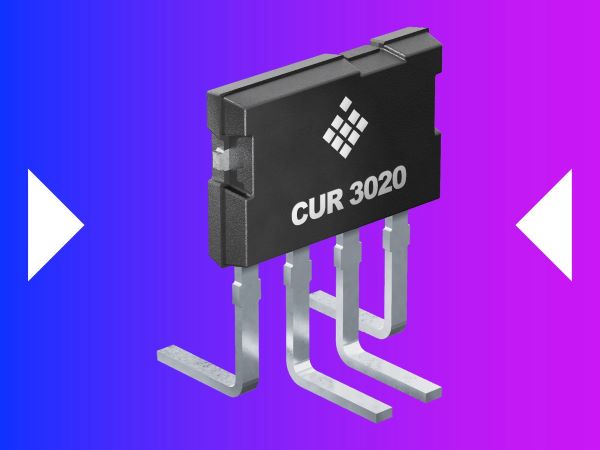
The CUR 3020 is a customer-programmable, low-noise, high-accuracy linear Hall effect current sensor IC with 250 kHz / 500 kHz selectable bandwidth options. This Hall-effect sensor IC provides a voltage output that is proportional to the applied magnetic field. The quiescent voltage output is centered at 2.5 V for bi-directional applications and is user-adjustable. The output sensitivity is programmable within a wide range of 4.2 to 67.4 mV/mT for various max current levels.
The accuracy of the device can be enhanced using one of three versatile programming methods outlined in the CUR 3020 programming guide. The device uses an EEPROM to optimize the device sensitivity and the QVO for a given application. The CUR 3020 is pre-optimized for performance over temperature providing low sensitivity and offset drift errors over the full automotive grade 0 range. There are various programming options available and outlined in the CUR 3020 programming guide, which can be shared by request.
It is housed in a 4-pin TO-92 package (UM) with a high-sensitivity Hall element for maximum accuracy. With user-selectable output voltage clamps that can be enabled or disabled, broken ground and wire detection, and over temperature diagnostics, the CUR 3020 is ideal for automotive applications. The hot ambient operating temperature of the part has increased to 165°C to support harsher xEV traction inverter environments for short periods of time.
Glossary
– AEC-Q100 Grade 0: Automotive qualification grade with extended high-temperature requirements
– C-core concentrator: Magnetic concentrator core used to guide magnetic flux from a current conductor to the Hall sensor element for current measurement
– CSM: Current Sensor Module, a sensor module with an IC and peripherals (concentrator, shielding, electronics/logic, connectors, housing); commonly used in industrial applications
– MPPT: Maximum power point tracking
– QVO: Quiescent voltage output (output voltage at zero magnetic field)
– xEV: Electrified vehicle (hybrid or battery electric)
Main applications*
– xEV traction inverter
– Personal mobility & AUX inverter
– Battery management and disconnect systems
– Industrial CSMs
Main features and benefits**
– Max sensitivity drift error 1% over –40 to 150°C
– Max offset drift error 5 mV over –40 to 150°C
– Programmable bandwidth 250 or 500 kHz
– Selectable sensitivity range between 4.2 and 67.4 mV/mT
– Integrated protections
o Undervoltage and overvoltage detection
o Optional output clamps (can be enabled or disabled separately)
o Open-circuit detection on ground pin and VSUP (broken wire)
o Reverse-voltage protection
o Programmable overtemperature diagnostics
– AEC-Q100 Qualification Grade 0, with increased TA = 165°C