
What Is an LM380 Audio Amplifier?
The LM380 is an integrated-circuit (IC) audio power amplifier designed to amplify low-level audio signals and drive speakers in various electronic applications. It features an internally fixed voltage gain of 50, equivalent to approximately 34 dB, which simplifies circuit design and reduces the need for external gain-setting components.
The LM380 offers low distortion, high input impedance, internal thermal protection, and short-circuit protection. Its 14-pin package includes a dedicated bypass pin, multiple ground pins, input terminals, and an output pin.

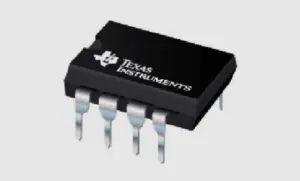
This IC is commonly used in audio amplification circuits because of its straightforward design and suitability for applications such as intercoms, radio receivers, alarms, and small audio systems.
LM380 Audio Amplifier Specifications
The important electrical specifications of the LM380 include the following:
- Recommended operating supply voltage: Typically 10 V to 22 V
- Absolute maximum supply voltage: Consult the specific manufacturer’s datasheet; it is commonly specified as 26 V
- Voltage gain: 50 (approximately 34 dB)
- Input impedance: Approximately 50 kΩ
- Peak output current capability: Approximately 1.3 A, subject to operating conditions and the manufacturer’s specifications
- Package: 14-pin DIP is a common version
- Output bias: Approximately half the supply voltage under typical single-supply operation
- Maximum junction temperature: Commonly 150°C
- Storage temperature range: Commonly −65°C to +150°C
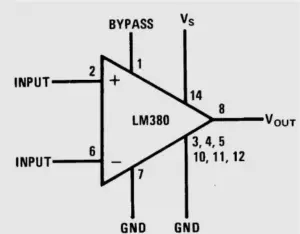
These values may vary with the manufacturer and device version. Always check the relevant datasheet before designing a circuit. Absolute maximum ratings are limits, not recommended operating conditions.
Pin Configuration of the LM380 Audio Amplifier
The LM380 commonly comes in a 14-pin package. Each pin has a specific function, and the ground pins help provide a suitable electrical reference and current-return path.
- Pin 1 – Bypass: Used to connect a bypass capacitor to reduce unwanted noise and improve supply-related performance.
- Pin 2 – Non-inverting input: Receives the audio input signal at the non-inverting input.
- Pin 3 – Ground: Ground connection.
- Pin 4 – Ground: Ground connection.
- Pin 5 – Ground: Ground connection.
- Pin 6 – Inverting input: Inverting input terminal.
- Pin 7 – Ground: Ground connection.
- Pin 8 – Output: Provides the amplified audio signal to the load through the appropriate circuit arrangement.
- Pin 9 – NC: No internal connection; leave unconnected unless the datasheet specifies otherwise.
- Pin 10 – Ground: Ground connection.
- Pin 11 – Ground: Ground connection.
- Pin 12 – Ground: Ground connection.
- Pin 13 – NC: No internal connection; leave unconnected.
- Pin 14 – VCC: Positive supply voltage.
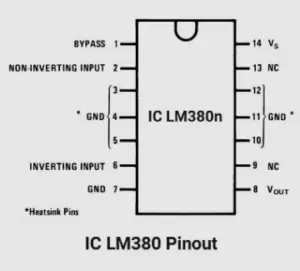
The exact pin functions should always be verified against the datasheet for the specific package and manufacturer.
LM380 Audio Amplifier Circuit Diagram
An LM380 audio amplifier circuit generally consists of an audio input source, coupling and bypass capacitors, the LM380 IC, a power supply, and a speaker or other suitable output load.
The input coupling capacitor blocks unwanted DC from the audio source while allowing the AC audio signal to reach the amplifier. The bypass capacitor connected to pin 1 can help reduce noise. The output stage delivers the amplified signal to the load. For reliable operation, use the manufacturer’s recommended circuit and capacitor values. Provide appropriate supply decoupling and ensure that the speaker impedance, output power, and heat dissipation remain within the IC’s ratings.
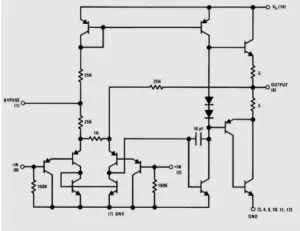
Internal Working of the LM380 Audio Amplifier
The LM380 uses internal transistor stages to amplify an audio signal. Its operation can be understood through the following functional stages.
1. Input Stage
The input stage receives the audio signal and provides the initial signal-processing function. The input circuitry is designed to offer relatively high input impedance, helping reduce the loading effect on the connected audio source.
2. Differential Amplifier Stage
The differential amplifier responds to the voltage difference between the input terminals. This stage helps control the signal presented to the subsequent voltage-amplification circuitry.
3. Voltage Amplification Stage
The voltage-amplification stage increases the signal level. The LM380 incorporates internal gain-setting circuitry that establishes a fixed overall voltage gain of approximately 50, or 34 dB.
4. Output Stage
The output stage supplies the current needed to drive an appropriate audio load. The IC includes internal protection features intended to help protect it from thermal overload and output short circuits under specified conditions.
How to Connect the LM380 Audio Amplifier
A typical LM380 application circuit can be assembled by following these general steps:
- Connect the positive supply to pin 14 and the circuit ground to the designated ground pins.
- Connect the audio source to the non-inverting input at pin 2 through a suitable coupling capacitor, following the recommended circuit.
- Connect the bypass capacitor between pin 1 and ground if required by the application circuit.
- Connect the speaker or other load to output pin 8 using the manufacturer’s recommended output arrangement.
- Add supply-decoupling capacitors close to the IC to reduce noise and unwanted oscillations.
- Verify the supply voltage, load impedance, capacitor polarity, and pin connections before powering on the circuit.
The exact component values and output coupling arrangement depend on the supply voltage, load, and design requirements. Refer to the relevant LM380 datasheet for a tested circuit.
Features of the LM380 Audio Amplifier
The major features of the LM380 audio amplifier are listed below:
- Internally fixed voltage gain of 50, approximately 34 dB.
- Single-supply operation for convenient circuit design.
- Output voltage that typically biases near half the supply voltage under normal operating conditions.
- Internal thermal protection.
- Short-circuit protection, subject to datasheet conditions.
- Relatively high input impedance.
- Low distortion when operated within its specified limits.
- Bypass terminal for improving noise performance.
- Simple external circuitry for many audio-amplifier applications.
Applications of the LM380 Audio Amplifier
The LM380 is suitable for a range of low-power audio applications, including:
- Intercom systems: Amplifies speech signals in communication equipment.
- TV sound systems: Can be used in suitable audio-output circuits.
- Radio receivers: Amplifies audio signals from AM and FM receiver stages.
- Alarm systems: Drives audio indicators and alert circuits.
- Phonograph amplifiers: Provides audio power amplification in compatible designs.
- Ultrasonic equipment: May be used in appropriate signal-driver applications within its frequency and electrical limits.
- Audio projects: Useful for educational circuits and small audio amplification systems.
Advantages of the LM380 Audio Amplifier
The LM380 simplifies the design of audio amplifiers by providing a fixed internal gain and integrated output circuitry. It reduces the number of external components required in many applications and incorporates protective features that improve robustness under specified conditions. Its relatively straightforward connections make it useful for educational electronics projects, basic audio equipment, and compact amplification designs.
Conclusion
The LM380 is a fixed-gain audio power amplifier IC used to amplify audio signals and drive suitable loads. Its gain of 50, relatively high input impedance, simple external circuitry, and built-in protection features make it useful in a variety of audio applications. For best results, choose the supply voltage and load according to the datasheet, provide proper decoupling, and verify all pin connections before operating the circuit.