


The 12-hour Hackathon gave students hands-on experience in secure identity challenges, supported by HID engineers, with winning teams sharing a ₹2 lakh prize pool.
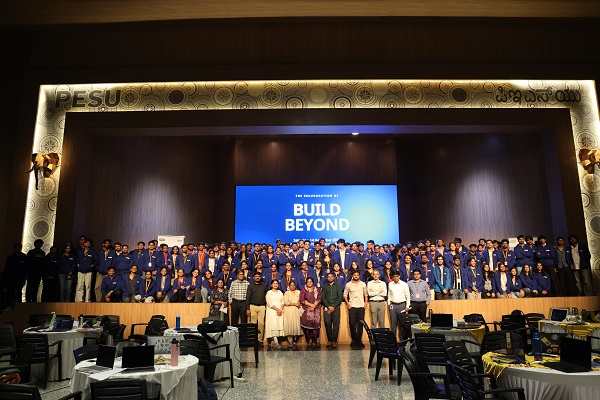
Bengaluru, India, November 17, 2026 – HID, a worldwide leader in trusted identity solutions, hosted its first campus hackathon in India at PES University, Bengaluru on November 14. Participated by 181 students across 51 teams, the students developed solutions addressing challenges in biometric authentication. Organised in association with PES University’s Department of Computer Applications, the 12-hour Hackathon themed Build Beyond provided students with an opportunity to apply their technical knowledge to real-world identity security challenges under the guidance of HID engineers.

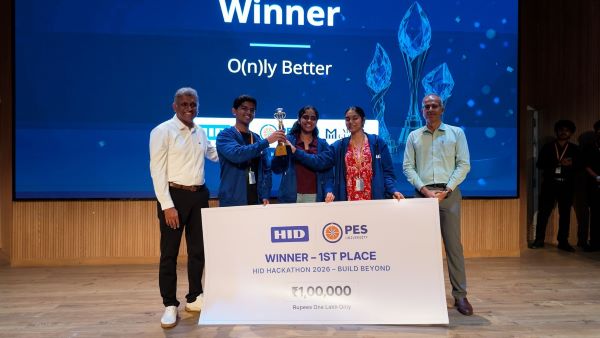
The hackathon concluded with Team O(n)ly Better securing first place, followed by Team FLOWSTATE as the First Runner-up and Team VISION-X as the Second Runner-up. The winning teams shared a prize pool of ₹2 lakh and received trophies and certificates, while all participating students received certificates of participation.
“We wanted students to experience first-hand the work our engineers do every day, tackling a real biometric security problem in our sandbox with HID engineers alongside them. For us, this is also about contributing to the community we are part of in India. Engaging with the country’s next generation of engineers is one of the best investments we can make in trusted identity, and we hope this is the first of many such initiatives on campus,” said Prabhuraj Patil, Senior Director, Physical Access Control Solutions, Asean & India Subcontinent, HID.
The challenge focused on facial authentication for secure physical access, such as entry to a building or a restricted area. Using their laptops’ integrated cameras, teams built a proof of concept that could register a user’s face, authenticate that person and reject attempts made with photographs or videos of them. Teams received the problem statement on the morning of the event and worked in a dedicated HID sandbox environment, with HID engineers mentoring them on the floor throughout the day.
Teams were evaluated by HID mentors and a jury across two rounds, and six finalists presented their prototypes to the jury in the final round. The jury comprised Prabhuraj Patil, Senior Director, Physical Access Control Solutions, Asean & India Subcontinent, HID; Saravan Kumar Gopalan, Senior Director, Engineering (Cloud & Mobile), Physical Access Control Solutions, HID; Kishore B T, Salesforce Architect and Salesforce MVP Hall of Fame; Prasad B Honnavalli, Professor, Department of Computer Science and Engineering, PES University; and Dr. Thenmozhi S, Professor, Department of Computer Applications, PES University.
“At PES University, we focus on giving students opportunities to learn beyond the classroom. Hackathons like HID’s Build Beyond are an important part of that experience, allowing students to apply their knowledge to real business and engineering challenges. They also motivate students to engage more deeply with what they learn during their degree programmes. For industry partners like HID, such initiatives offer an opportunity to see what talented, motivated students can accomplish in a short period of time,” said Dr. Shishir Nagaraja, Pro Vice-Chancellor, PES University.
The winning team, O(n)ly Better, developed an AWS-based facial authentication kiosk for secure physical access, combining facial recognition, liveness detection and safeguards against photo and video spoofing. The solution also incorporated campus access permissions and security measures for network disruptions.
HID has set up engineering centres in Bengaluru and Chennai, with its Global Engineering Team based in Chennai. The Hackathon builds on this presence by connecting students with experienced engineers working on trusted identity and security technologies. Held ahead of the placement season, the initiative also offered students practical exposure to problem-solving, prototype development and the technical considerations involved in building secure identity solutions.
“The hackathon was a genuinely rewarding experience. The additional challenges pushed us to think beyond building a working prototype and consider how our solution would perform in real-world situations. The guidance from HID engineers helped us understand the importance of security, scalability and reliable system design. It was a great opportunity to experiment, learn and see what goes into developing a solution that could eventually work in a real environment,” said Ria M Parikh, leader of Team O(n)ly Better.
The hackathon was open to B.Tech students in Computer Science, Artificial Intelligence and Machine Learning, and Electronics and Communication from the fifth semester onwards, MCA students across all years and final-year BCA students. Up to 51 teams of three to four students were shortlisted from the applications received.