

What is Magnetic Hysteresis?
Magnetic hysteresis is the phenomenon in which the magnetic flux density (B) or magnetization of a magnetic material lags behind the applied magnetic field strength (H) when the magnetic field is varied.
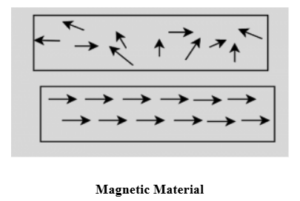

When a magnetic material is magnetized and then subjected to a changing magnetic field, its magnetization does not follow the same path during magnetization and demagnetization. This behaviour produces a closed curve known as the magnetic hysteresis loop.
Magnetic Materials
Magnetic materials such as iron can retain some magnetism even after the external magnetic field is removed. This property is known as residual magnetism. The retained magnetism can be reduced by applying a magnetic field in the opposite direction or by heating the material appropriately.
Magnetic materials are commonly classified into the following categories:
- Diamagnetic materials
- Paramagnetic materials
- Ferromagnetic materials
- Antiferromagnetic materials
Magnetic hysteresis is most clearly observed in ferromagnetic materials because they can retain magnetization after the external magnetic field is removed.
Magnetic Hysteresis Loop
A magnetic hysteresis loop represents the relationship between magnetic flux density (B) and magnetic field strength (H) in a magnetic material. It is obtained by repeatedly changing the applied magnetic field and measuring the corresponding flux density.
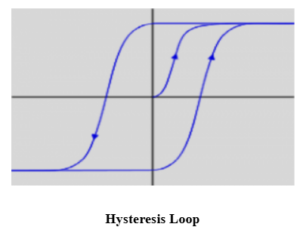
The formation of a hysteresis loop can be explained through the following stages:
1. Initial Magnetization
When the magnetic field strength (H) is gradually increased from zero, the magnetic flux density (B) also increases. The magnetic domains inside the material begin to align in the direction of the applied magnetic field.
2. Magnetic Saturation
As the magnetic field strength increases, the flux density continues to rise until the material reaches magnetic saturation. At this point, most of the magnetic domains are aligned, and a further increase in the magnetic field produces only a small increase in magnetization.
3. Retentivity or Residual Magnetism
When the applied magnetic field is reduced to zero, the magnetic flux density does not immediately become zero. Some magnetism remains in the material. This remaining flux density is known as residual magnetism or retentivity.
4. Coercive Force
To remove the residual magnetism, a magnetic field must be applied in the opposite direction. The reverse magnetic field strength required to reduce the magnetic flux density to zero is known as the coercive force or coercivity.
5. Reverse Saturation
If the reverse magnetic field is increased further, the material reaches magnetic saturation in the opposite direction.
6. Completion of the Hysteresis Loop
When the magnetic field is gradually reversed again, the material follows another path through the B-H graph. After completing one full cycle of magnetization, a closed hysteresis loop is formed.
Magnetization or B-H Curve
The B-H curve represents the relationship between magnetic flux density (B) and magnetic field strength (H). When the magnetic field is increased, the flux density also increases initially. However, after reaching a certain value, the material approaches magnetic saturation.
Magnetic saturation occurs because most of the magnetic domains inside the material become aligned with the applied magnetic field. Once the material approaches this condition, further increases in magnetic field strength produce only a small increase in flux density. The point at which the material reaches its maximum practical magnetization is known as the saturation point.
Magnetic Hysteresis Loops for Soft and Hard Magnetic Materials
Magnetic hysteresis behaviour differs according to the type of magnetic material. Soft and hard magnetic materials have different hysteresis loop characteristics.
1. Hysteresis Loop in Soft Magnetic Materials
Soft magnetic materials have a narrow hysteresis loop, low coercivity, and low retentivity. They can be magnetized and demagnetized easily.
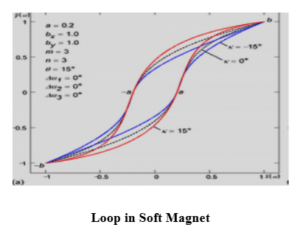
Because of their narrow hysteresis loop, they have relatively low hysteresis losses. These materials are commonly used in transformers, motors, generators, and electromagnets.
2. Hysteresis Loop in Hard Magnetic Materials
Hard magnetic materials have a wider hysteresis loop, high coercivity, and high retentivity. They retain their magnetism even after the external magnetic field is removed.
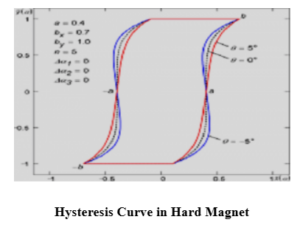
These materials are commonly used for making permanent magnets and magnetic storage devices.
Residual Magnetism or Retentivity
Residual magnetism is the magnetic flux density that remains in a magnetic material after the external magnetizing field is reduced to zero. The ability of a material to retain this magnetism is known as retentivity. Materials with high retentivity are suitable for permanent magnet applications.
Coercive Force or Coercivity
Coercive force is the reverse magnetic field strength required to reduce the residual magnetic flux density of a material to zero after magnetization. It indicates how strongly a material resists demagnetization. Hard magnetic materials have high coercivity, whereas soft magnetic materials have low coercivity.
Hysteresis Loss
When a magnetic material is repeatedly magnetized and demagnetized, some energy is dissipated in the form of heat. This energy loss is known as hysteresis loss. The energy lost per unit volume during one complete magnetization cycle is represented by the area enclosed by the B-H hysteresis loop. Therefore, a wider hysteresis loop generally indicates greater hysteresis loss for the same operating conditions. Hysteresis losses occur in transformers, motors, generators, and other AC magnetic devices because their magnetic fields change continuously during operation.
Applications of Magnetic Hysteresis
Magnetic materials with different hysteresis characteristics are used in various electrical and electronic devices.
Applications of Hard Magnetic Materials
- Permanent magnets
- Hard disk drives
- Magnetic recording equipment
- Magnetic tapes and cassettes
- Magnetic cards
Applications of Soft Magnetic Materials
- Transformers
- Solenoids
- Electromagnets
- Relays
- Electric motors and generators
Conclusion
Magnetic hysteresis is an important property of magnetic materials in which magnetization lags behind the applied magnetic field. The hysteresis loop explains important magnetic characteristics such as saturation, retentivity, and coercivity. Soft magnetic materials are preferred for applications requiring easy magnetization and low energy loss, while hard magnetic materials are used where strong and permanent magnetism is required.