
Introduction
In computer networks, a star topology is based on a spoke-hub structure. Every device (node) is connected directly to a central hub, switch, or router, forming a star-like pattern. The hub acts as a central point through which all data flows before reaching its destination. It also manages and controls network functions and often works as a repeater.
Star topology minimizes the impact of transmission line failures because each device is connected independently to the hub. If a single connection fails, only that device is affected while the rest of the network continues to operate normally.
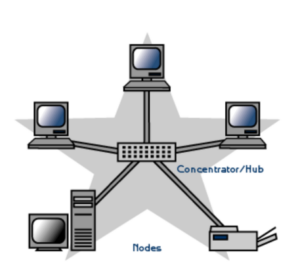
Twisted pair cables and optical fiber cables are commonly used for this topology, although coaxial cables may also be used in certain applications such as video routers. A point-to-point connection is required between the central device and each networked device. The central hub can also recondition and amplify signals to improve communication quality.
Star topology is widely used in home networks and small business networks due to its reliability and ease of expansion. It also allows simple addition or removal of devices without disrupting the entire network.
How Star Topology Works
In star topology, devices cannot communicate directly with each other. Instead, all data travels to a central device (hub or switch), which then forwards the data to the intended destination. Depending on the type of central device used, star topology can be classified into:
- Passive Star Topology
- Active Star Topology
- Star Topology Using a Switch
Although the physical layout remains the same, the functioning differs based on the device at the center.
1. Passive Star Topology
A passive hub is used as the central device. It receives signals from the sender and simply forwards them to all connected nodes without regenerating or amplifying the signal. Each receiving node checks the destination address to determine whether the data is meant for it.
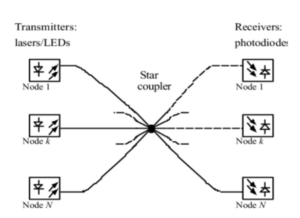
Because the passive hub cannot regenerate signals, this type is unsuitable for large or long-distance networks.
2. Active Star Topology
An active hub serves as the central device. Unlike a passive hub, an active hub regenerates and amplifies signals before forwarding them to other nodes. This helps maintain strong signal quality even over long cable lengths.

Active star topologies are more suitable for larger networks and environments requiring stable signal transmission.
3. Star Topology Using a Switch
A switch can also be used as the central device in a star topology, creating what is commonly known as a switched star network. A switch is an intelligent device that reads the destination address of a data packet and forwards it only to the intended recipient. This method is known as unicast transmission.
Switches provide additional functions such as:
- Routing
- Signal processing or regeneration
- Bridging
- Network management
Because switches reduce unnecessary broadcasts and improve performance, they are typically preferred over hubs when building star topology networks.
Advantages of Star Topology
- Centralized network management: Easy to monitor and manage the network using the central hub or switch.
- Easy to add or remove nodes: Devices can be added or removed without affecting the rest of the network.
- Highly reliable: If one device or cable fails, the rest of the network continues functioning normally.
- Low collision risk: Each device has its own dedicated connection, reducing the chances of data collision.
- Simple fault detection: Faults are easy to identify because each device connects directly to the central hub.
- No signal reflection issues: Data transmission is secure and stable through point-to-point communication.
- Expandable: Multiple star networks can be interconnected to extend coverage, provided the central device supports the required load.
Disadvantages of Star Topology
- High cost: Implementing hubs, switches, and long cables can be more expensive than other topologies.
- Central device dependency: The entire network depends on the central hub/switch. If it fails, the entire network goes down.
- Maintenance required: The central device often requires more resources and maintenance.
- Damage-prone cabling: Long cable runs may be exposed to environmental or physical damage.
- Wireless star has slower performance: Wireless star networks (WLAN) often have lower data transfer speeds and risk bottlenecks.
- Limited movement: In wired setups, cable length restricts the placement and mobility of devices.