
Semiconductor for You
  • Home
  • Semiconductor News
  • Semiconductor Magazine
  • Technology
    • Automotive
    • Consumer Electronics
    • IoT
    • Test and Measurement
    • Lighting
    • Power Management
    • Wireless
    • Personal Electronics
    • Hardware & Software
    • Research
    • Medical Electronics
    • Embedded Design
    • Aerospace & Defence
    • Artificial Intelligence
  • Interview
  • Industries
  • Market
  • Knowledge Base
  • Events
  • Tools
    • Resistor Color Code Calculator
No Result
View All Result
  • Home
  • Semiconductor News
  • Semiconductor Magazine
  • Technology
    • Automotive
    • Consumer Electronics
    • IoT
    • Test and Measurement
    • Lighting
    • Power Management
    • Wireless
    • Personal Electronics
    • Hardware & Software
    • Research
    • Medical Electronics
    • Embedded Design
    • Aerospace & Defence
    • Artificial Intelligence
  • Interview
  • Industries
  • Market
  • Knowledge Base
  • Events
  • Tools
    • Resistor Color Code Calculator
No Result
View All Result
Semiconductor for You
No Result
View All Result
Home Articles

What is TRIAC?

Semiconductor For You by Semiconductor For You
May 25, 2021
in Articles
0

The TRIAC stands for triode for alternating current (AC). The TRIAC is another thyristor family device which is used extensively for the control of power in A.C. circuits.

Where the thyristor can only control current over one half of the cycle, the TRIAC controls it over two half of an AC waveform.

Construction:

The TRIAC is bidirectional device and when in operation, it is equivalent to two silicon controlled rectifiers (SCRs) connected in anti parallel.

It has a four layer (PNPN) and three junction devices. It has three terminals designated as a main terminal 1 (MT1), main terminal 2 (MT2) and gate G.

We can see that the terminal MT2 is common to N4 as well as P1, the terminal MT1 is common to N2 as well as P2 and G is common to N3 as well as P2.

This different type of construction of TRIAC makes it suitable to be operated in four modes. The TRIAC is turned ON by applying a positive or negative voltage to the gate with respect to MT1.
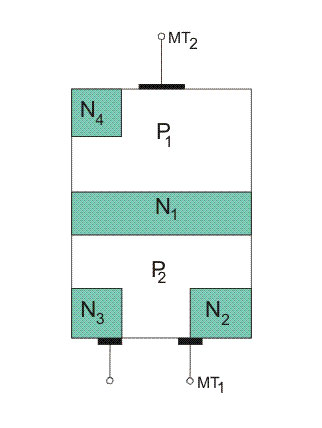
TRIAC
TRIAC
Semiconductor For You

Semiconductor For You

Browse by Category

  • Aerospace and Defence
  • Articles
  • Automotive
  • Consumer-Electronics
  • Hardware & Software
  • Interview
  • IoT
  • Knowledge Base
  • Lighting
  • Market
  • personal-electronics
  • Power Management
  • Research
  • Semiconductor Events
  • Semiconductor News
  • Technology
  • Test and Measurement
  • Uncategorized
  • Wireless
Semiconductor For You

Semiconductor For You is a resource hub for electronics engineers and industrialist. With its blend of
technology features, news and new product information, Semiconductor For You keeps designers and
managers up to date with the fastest moving industry in the world.

Follow Us

Browse by Category

  • Aerospace and Defence
  • Articles
  • Automotive
  • Consumer-Electronics
  • Hardware & Software
  • Interview
  • IoT
  • Knowledge Base
  • Lighting
  • Market
  • personal-electronics
  • Power Management
  • Research
  • Semiconductor Events
  • Semiconductor News
  • Technology
  • Test and Measurement
  • Uncategorized
  • Wireless

Recent News

Infineon introduces the AIROC™ UWB TSL100 for precise positioning and smart presence detection on a single chip

Infineon introduces the AIROC™ UWB TSL100 for precise positioning and smart presence detection on a single chip

June 25, 2026
Arrow Electronics works with STMicroelectronics to accelerate industrial AMR development with a new reference platform

Arrow Electronics works with STMicroelectronics to accelerate industrial AMR development with a new reference platform

June 25, 2026
  • About
  • Advertise
  • Privacy & Policy
  • Contact

© 2022 Semiconductor For You

No Result
View All Result
  • Home
  • Semiconductor News
  • Technology
    • IoT
    • Wireless
    • Power Management
    • Automotive
    • Hardware & Software
  • Market
  • Interview
  • Knowledge Base
  • Tools
    • Resistor Color Code Calculator

© 2022 Semiconductor For You