• Home
  • About Us
  • Contact Us
Semiconductor for You
  • Home
  • Semiconductor News
  • Semiconductor Magazine
  • Technology
    • Automotive
    • Consumer Electronics
    • IoT
    • Lighting
    • Power Management
    • Wireless
    • Personal Electronics
    • Hardware & Software
    • Research
    • Medical Electronics
    • Embedded Design
    • Aerospace & Defence
    • Artificial Intelligence
  • Interview
  • Industries
  • Market
  • Knowledge Base
  • Events
  • Tools
    • Resistor Color Code Calculator
No Result
View All Result
  • Home
  • Semiconductor News
  • Semiconductor Magazine
  • Technology
    • Automotive
    • Consumer Electronics
    • IoT
    • Lighting
    • Power Management
    • Wireless
    • Personal Electronics
    • Hardware & Software
    • Research
    • Medical Electronics
    • Embedded Design
    • Aerospace & Defence
    • Artificial Intelligence
  • Interview
  • Industries
  • Market
  • Knowledge Base
  • Events
  • Tools
    • Resistor Color Code Calculator
No Result
View All Result
Semiconductor for You
No Result
View All Result
Home Knowledge Base

Power Triangle and Power Factor

Komal Ganvir by Komal Ganvir
December 26, 2025
in Knowledge Base
0

Introduction

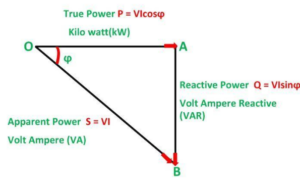
The power triangle is a right-angled triangle that represents the relationship between active power, reactive power, and apparent power in an AC circuit. It provides a clear graphical understanding of how power components interact when voltage and current are not in phase. When the active component of current (Icosφ) and the reactive component of current (Isinφ) are multiplied by the supply voltage V, the power triangle is obtained, as shown conceptually in standard AC circuit diagrams.

Types of Power in AC Circuits

Active Power (True Power)

Active power is the power that is actually consumed or utilized in an AC circuit to perform useful work such as producing mechanical output in motors, heat in heaters, or light in lamps. It is measured in kilowatts (kW) or megawatts (MW) and is the only form of power that performs real work. Active power is measured using a wattmeter.

Reactive Power

Reactive power is the power that continuously flows back and forth between the source and reactive elements of the circuit such as inductors and capacitors. It does not perform any useful work but is necessary to establish electric and magnetic fields.

Reactive power is measured in kilovolt-ampere reactive (kVAR) or megavolt-ampere reactive (MVAR). It plays a major role in determining the circuit’s power factor.

Apparent Power

Apparent power is defined as the product of the root mean square (RMS) values of voltage and current in an AC circuit. It is measured in kilovolt-ampere (kVA) or megavolt-ampere (MVA) and represents the total power supplied by the source.

Relationship Between Power Components

When the active component of current is multiplied by the circuit voltage, it produces active power. This power is responsible for useful work output.

When the reactive component of current is multiplied by the circuit voltage, it results in reactive power, which flows back and forth in the circuit without being consumed. When the total circuit current is multiplied by the circuit voltage, the result is apparent power.

Power Factor

From the power triangle, the power factor can be determined as the ratio of active power to apparent power.

Power Factor (cosφ) = Active Power / Apparent Power = kW / kVA

In AC circuits, except for purely resistive loads, there is generally a phase difference between voltage and current. Due to this phase difference, the product of voltage and current (VI) does not represent the true power consumed by the circuit.

Conclusion

The power triangle is a fundamental concept in AC circuit analysis that visually explains the relationship between active, reactive, and apparent power. Understanding power factor is essential for improving power efficiency, reducing losses, and optimizing electrical system performance.


Content Protection by DMCA.com
Tags: Power Triangle and Power Factor
Komal Ganvir

Komal Ganvir

Browse by Category

  • Aerospace and Defence
  • Articles
  • Automotive
  • Consumer-Electronics
  • Hardware & Software
  • Interview
  • IoT
  • Knowledge Base
  • Lighting
  • Market
  • personal-electronics
  • Power Management
  • Research
  • Semiconductor Events
  • Semiconductor News
  • Technology
  • Wireless
Semiconductor for You

Semiconductor For You is a resource hub for electronics engineers and industrialist. With its blend of
technology features, news and new product information, Semiconductor For You keeps designers and
managers up to date with the fastest moving industry in the world.

Follow Us

Browse by Category

  • Aerospace and Defence
  • Articles
  • Automotive
  • Consumer-Electronics
  • Hardware & Software
  • Interview
  • IoT
  • Knowledge Base
  • Lighting
  • Market
  • personal-electronics
  • Power Management
  • Research
  • Semiconductor Events
  • Semiconductor News
  • Technology
  • Wireless

Recent News

Sinusoidal Waveforms: Definition, Mathematics, Generation Methods and Applications

Sinusoidal Waveforms: Definition, Mathematics, Generation Methods and Applications

December 26, 2025
Power Triangle and Power Factor

Power Triangle and Power Factor

December 26, 2025
  • About
  • Advertise
  • Privacy & Policy
  • Contact

© 2022 Semiconductor For You

No Result
View All Result
  • Home
  • Semiconductor News
  • Technology
    • IoT
    • Wireless
    • Power Management
    • Automotive
    • Hardware & Software
  • Market
  • Knowledge Base
  • Tools
    • Resistor Color Code Calculator

© 2022 Semiconductor For You