
Introduction
A DC Generator is an electrical machine that converts mechanical energy into direct current (DC) electrical energy. It operates on the principle of electromagnetic induction discovered by Michael Faraday. DC generators have played a significant role in the development of electrical engineering and continue to be used in various industrial and specialized applications.
The first electromagnetic generator, known as the Faraday Disc, was invented by British scientist Michael Faraday in 1831. A DC generator is an electrical machine designed to convert mechanical energy into electrical energy in the form of direct current (DC). Mechanical energy for DC generators can be supplied by various sources, including:

- Hand cranks
- Internal combustion engines
- Water turbines
- Gas turbines
- Steam turbines
Generators are essential components of electrical power systems. Interestingly, a DC generator can also operate as a DC motor when electrical energy is supplied to it. Thus, motors and generators share many similar constructional features and operating principles.
What is a DC Generator?
A DC Generator (Direct Current Generator) is an electrical machine whose primary function is to convert mechanical energy into direct current electrical energy. This energy conversion process is based on the principle of electromagnetic induction.
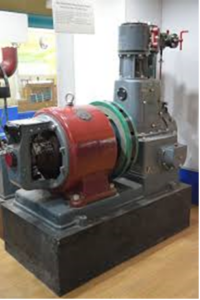
DC Generator
According to Faraday’s Law of Electromagnetic Induction, whenever a conductor cuts magnetic flux, an electromotive force (EMF) is induced in the conductor. If the conductor circuit is closed, the induced EMF produces an electric current.
Construction of DC Generator
A DC generator has a construction similar to that of a DC motor. Therefore, a DC machine can function either as a generator or as a motor without requiring major structural modifications. The major components of a DC generator include:
- Stator
- Rotor (Armature Core)
- Armature Windings
- Yoke
- Poles
- Pole Shoes
- Commutator
- Brushes
The two primary parts of a DC generator are the stator and the rotor.
Stator
The stator is the stationary part of the DC generator. Its primary function is to create the magnetic field required for the operation of the machine. The stator contains magnetic poles arranged with opposite polarities to establish a magnetic field within the rotor area.
Rotor or Armature Core
The rotor, also known as the armature core, is the rotating component of the DC generator. It is constructed from laminated iron sheets stacked together to form a cylindrical structure. The laminated construction helps reduce eddy current losses.
Armature Windings
The armature windings are placed within the slots of the armature core. These windings are connected in series or parallel configurations to increase the generated current and voltage output.
Yoke
The yoke forms the outer frame of the DC generator and is typically made of cast iron or steel. It provides mechanical support and acts as a low-reluctance path for magnetic flux.
Poles
The poles support the field windings, which are wound around them. These field windings generate the magnetic field necessary for the generator’s operation. The poles are securely attached to the yoke using welding or mechanical fastening.
Pole Shoes
Pole shoes are attached to the poles to distribute the magnetic flux uniformly and provide support to the field windings.
Commutator
The commutator acts as a mechanical rectifier, converting the alternating current (AC) generated within the armature winding into direct current (DC) at the output terminals. The commutator consists of copper segments insulated from one another using mica sheets and is mounted on the shaft of the machine.
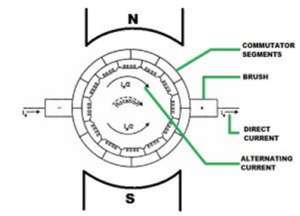
Commutator in DC Generator
Function of Commutator in DC Generator
The primary function of the commutator is to convert the internally generated alternating current into direct current. The electromotive force induced in the armature conductors is inherently alternating. As the armature rotates, the commutator reverses the connections of the armature coils whenever they cross the magnetic neutral axis. This switching action ensures that the output current supplied to the external circuit remains unidirectional. The commutator also provides continuous electrical contact between the rotating armature and the stationary load circuit through the brushes.
Brushes
Brushes maintain electrical contact between the commutator and the external load circuit. They are generally made of carbon or graphite to minimize wear and ensure reliable operation.
Working Principle of DC Generator
The working principle of a DC generator is based on Faraday’s Law of Electromagnetic Induction. According to this law, whenever a conductor moves within a magnetic field and cuts magnetic flux lines, an electromotive force (EMF) is induced in the conductor. In a DC generator:
- The field windings produce a magnetic field.
- The armature conductors rotate within this magnetic field.
- The rotating conductors cut the magnetic flux.
- An electromotive force is induced in the conductors.
- The commutator converts the internally generated AC into DC.
The direction of the induced current can be determined using Fleming’s Right-Hand Rule.
Advantages of DC Generator
- Capable of generating large output power.
- Can handle high terminal loads.
- Simple construction and design.
- Suitable for generating varying output power.
- Provides reliable output voltage.
- Offers efficiency ratings between 85% and 95%.
- Compact and lightweight design.
- Easy voltage control.
Disadvantages of DC Generator
- Cannot be operated directly with transformers.
- Efficiency decreases due to copper, mechanical, and eddy current losses.
- Voltage drops occur during long-distance transmission.
- The split-ring commutator increases construction complexity.
- Relatively expensive.
- Requires frequent maintenance.
- Sparking occurs at the commutator and brushes.
- Higher transmission losses compared to AC systems.
Applications of DC Generators
Separately Excited DC Generator
- Electroplating processes
- Voltage boosting applications
- Power supply and lighting systems using field regulators
Self-Excited (Shunt) DC Generator
- General power supply applications
- Lighting systems
- Battery charging systems
Series DC Generator
- Arc lamps
- Constant current generators
- Voltage booster applications
Compound DC Generator
- DC welding machines
- Industrial power supplies
- Heavy load applications
Level Compound DC Generator
- Power supply for offices
- Hostels
- Lodges
- Commercial buildings
Over Compound DC Generator
- Compensation of voltage drops in feeders
- Power distribution systems
Conclusion
A DC generator is an important electrical machine that converts mechanical energy into direct current electrical energy through electromagnetic induction. Despite the widespread use of AC power systems, DC generators remain valuable in applications requiring controlled DC output, electroplating, welding, battery charging, and industrial processes. Their simple operating principle and reliable performance continue to make them relevant in specialized applications.