
Bengaluru edition closes with 793 exhibitors, 52,411 business visitors, 3,225 B2B meetings and an industry agenda centred on sourcing, production capability and technology adoption
- International participation from over 50 countries included dedicated pavilions from Germany, Japan, Taiwan and China.
- Approximately 150 speakers addressed manufacturing policy, capital goods, exports, AI, PCBs, standards and flexible electronics across 18 supporting programmes.
- New initiatives connected industry with emerging talent through the Tech Challenge, AI Buildathon, Hand Soldering Test and CMTI industrial visit.
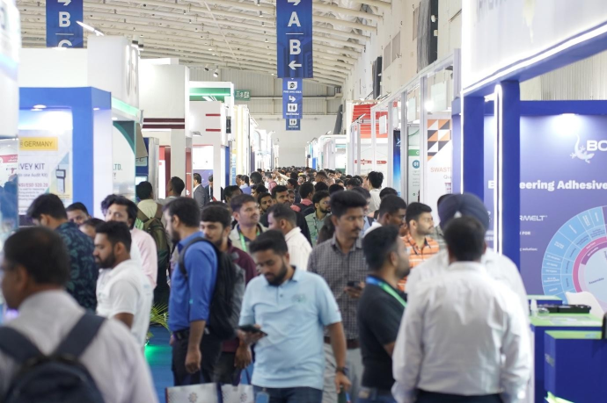
Bengaluru, September 2026: From identifying new component suppliers to evaluating production equipment and addressing gaps in domestic manufacturing, electronica India and productronica India 2026 concluded in Bengaluru after three days of focused commercial and technical engagement across the electronics value chain.

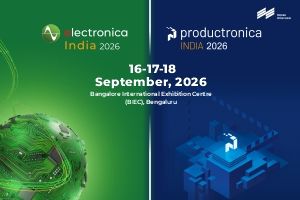
Organised by Messe Muenchen India from 16–18 September 2026 at the Bangalore International Exhibition Centre (BIEC), the co-located trade fairs welcomed 793 exhibitors and 52,411 business visitors. The exhibition occupied 60,000 square metres and featured exhibiting companies from over 30 countries. Together, visitors, exhibitors, speakers and industry delegations represented more than 50 countries.
The event covered electronic components, embedded technologies, printed circuit boards, electronic manufacturing services, production machinery, automation, testing, inspection and related manufacturing solutions. Its breadth allowed decision-makers to examine several stages of electronics production within a single business platform.
The Bengaluru edition was inaugurated by Shri M. B. Patil, Hon’ble Minister for Large and Medium Industries and Infrastructure Development, Government of Karnataka, and Mr. Hiroshi Nawata, Consul-General of Japan in Bengaluru.
Industry attention shifts from capacity to capability
The conversations across the exhibition indicated a clear industry priority: increasing manufacturing capacity must now be supported by stronger capabilities in components, equipment, quality, testing, design and production processes.
Manufacturers attending the event evaluated technologies against practical requirements such as application suitability, production output, process control, inspection accuracy, automation and supplier support. Component and equipment providers, in turn, gained direct exposure to the requirements emerging from Indian electronics manufacturers.
Bhupinder Singh, President – IMEA, Messe München, and CEO, Messe Muenchen India, said, “The value of a trade fair is ultimately determined by the quality of the business conversations it enables. In Bengaluru, we saw manufacturers arriving with specific sourcing, production and technology requirements. Suppliers were able to respond with relevant capabilities and technical expertise. This level of engagement shows that India’s electronics sector is progressing from broad expansion plans towards more defined manufacturing decisions.”
The Buyer–Seller Forum supported this process through 3,225 focused B2B meetings over three days with 645 unique buyer companies and 1,682 VIP buyers. The discussions gave both sides a structured setting to examine technical requirements, supplier capabilities and potential areas of cooperation.
The exhibition floor was complemented by the Podcast Studio, Executive Club Lounge and dedicated networking areas, creating additional settings for conversations among business leaders, technology specialists and industry representatives.
International participation reflects demand for closer market engagement
Companies from Germany, China, France, Italy, the United Kingdom, Japan, Israel, the United States, Korea and other markets participated in the Bengaluru edition.
Dedicated pavilions from Germany, Japan, Taiwan and China brought together technologies and suppliers from their respective electronics industries. The Japan Pavilion was organised in partnership with the Japan External Trade Organization (JETRO), while the Taiwan Pavilion was presented with the Taiwan Electrical and Electronic Manufacturers’ Association (TEEMA).
Rather than serving only as international showcases, the pavilions enabled participating companies to hold direct discussions with Indian buyers, understand local manufacturing requirements and explore potential commercial relationships.
Dr. Reinhard Pfeiffer, CEO, Messe München GmbH, said, “Global electronics companies are increasingly in need of a closer understanding of India’s manufacturing requirements and business environment. The Bengaluru edition gave international suppliers direct access to the companies investing in production, sourcing and technology adoption. For Indian participants, it provided an efficient way to compare the capabilities of several established technology markets.”
Conference discussions examine the foundations of competitive manufacturing
The accompanying programme moved the industry conversation beyond manufacturing volume to the capabilities required for long-term competitiveness.
The India Electronics Conclave comprised 14 conferences at the BIEC Conference Centre. Across the event, approximately 150 speakers participated in 18 supporting programmes covering electronics policy, capital goods, artificial intelligence, exports, free trade agreements, printed circuit boards, flexible electronics, standards, compliance and power electronics.
The programme included the eFuture Conference with Avanteum as Knowledge Partner, CEO Forum with ELCINA, Industrial Electronics & Capital Goods Summit 2026 with ICEA, Exports and FTAs: Electronics Sector with MEDEPC, Bharat PCB Tech Conference with ELCINA, VDMA Symposium and OE-A Symposium on Flexible Electronics.
Reinforcing its role as a platform for industry dialogue and future-focused thinking, electronica India and productronica India 2026 hosted the launch of MMI and Avanteum Advisors’ e-paper, eFuture 2035: Engineering India’s Next Electronics Revolution. The report outlines the strategic shifts and opportunities that could shape India’s electronics manufacturing and its position in the global value chain over the next decade.
Technical learning was addressed through the IEEE Standards Workshop on EMI/EMC Compliance and the Power Electronics & Power Supply Design Workshop.
“India’s electronics industry is entering a phase where competitiveness will be measured by consistency, reliability, process maturity and the ability to meet global customer expectations. Forums at electronica India and productronica India 2026 helped bring sharper attention to these priorities by connecting industry leaders, technology providers and policy stakeholders around the practical capabilities required to move from capacity creation to globally competitive manufacturing,” said Rajoo Goel, Secretary General, ELCINA.
The Industrial Electronics & Capital Goods Summit 2026, organised with the India Cellular & Electronics Association, examined the role of domestically available equipment and production technologies in supporting manufacturing growth.
Shri Pankaj Mahindroo, Chairman, India Cellular & Electronics Association (ICEA), said: “As India’s electronics manufacturing ecosystem continues to expand, reliable access to advanced equipment, automation, testing and quality-control technologies will be critical to sustaining growth. The summit provided an important platform for industry and policymakers to examine these requirements from the perspective of real-world production needs and identify the areas where India’s capital-goods and technology ecosystem must continue to evolve.”
The OE-A Symposium brought international and Indian experts together to consider the commercial potential of flexible and printed electronics across mobility, healthcare, energy, consumer products and industrial applications.
Sandip Roy, General Manager, VDMA India, said, “The opportunity in flexible electronics depends on connecting research and technology development with viable industrial applications. The symposium created a useful exchange between international specialists and Indian stakeholders exploring how these technologies can move towards adoption and commercial deployment.”
Speakers participating in the supporting programme said that the value of the discussions lay in bringing policy, manufacturing experience and technical expertise into the same forum.
“The session provided an opportunity to examine the emerging power paradigm in the context of the decisions manufacturers are making today. The discussion highlighted the immediate challenges facing the industry, while also bringing into focus the technologies and capabilities that need to be developed to meet the evolving demands of power electronics over the coming years,” said Amit Kumar, Vice President & Business Unit Head – Metering and Protection Systems, Schneider Electric India.
“India has a significant opportunity to strengthen its position in next-generation PCB design to manufacturing, but realising this potential will require closer collaboration among industry, government, academia and technology providers. The event brought these stakeholders together for a practical and meaningful exchange of perspectives on bridging the journey from design to manufacturability,” said
Savita Ganjigatti, Sr. Vice President – Engineering & Operations, Sienna ECAD Technologies (An Avalon Group Company), during the session Engineering for Tomorrow: Design to Manufacturing.
Emerging engineers work on industry-defined challenges
The 2026 edition also introduced formats designed to connect emerging technical talent with practical industry problems.
Organised with HackCulture and supported by presenting partner DigiKey, the electronica India Tech Challenge featured a prize pool of ₹5 lakh. Participating teams developed responses to defined technology challenges and presented their work during the Hackathon Demo Day, where the three winning teams were recognised for the originality, technical merit and practical relevance of their solutions.
The AI Buildathon, conducted by Sarvam AI, and AI Masterclass conducted by GrowthX, explored the application of artificial intelligence to practical use cases. A Hand Soldering Skill Test brought attention to production skills at the operator level, while an industrial visit to the Central Manufacturing Technology Institute provided exposure to an established manufacturing and engineering environment.
At electronica India 2026, the Taipei Computer Association and IIIT-Bangalore signed an LoI to advance Taiwan–India collaboration across AI, electronics, smart manufacturing, smart cities and cybersecurity.
Together, these initiatives connected the event’s wider manufacturing agenda with engineering skills, applied problem-solving and future workforce requirements.
‘India’s Powerplay in Electronics’ reaches the industry nationwide
The Bengaluru edition was presented under the theme “India’s Powerplay in Electronics.” Cricket icon KL Rahul served as Brand Ambassador for the visitor campaign, which ran across outdoor, digital and print media through September 2026. At the event, the campaign shifted from a public-facing message to a physical demonstration of the breadth of companies, technologies and expertise in India’s electronics industry.
Exhibitors and buyers report focused business engagement
Exhibitors highlighted the quality of conversations with manufacturers, sourcing teams and technology decision-makers attending the Bengaluru edition.
“productronica India 2026 gave us a strong platform to showcase advanced technologies with our global partners. Unveiling Fuji’s CLT-FG for the first time outside Japan was the main highlight. The strong industry response reinforced the growing demand for advanced manufacturing solutions in India and opened new opportunities for collaboration,” said Soni Saran Singh, Founder, MD & CEO, NMTronics India Pvt. Ltd.
“India’s electronics ecosystem is evolving rapidly, with growing focus on technology adoption, local manufacturing and stronger supply chains. The exhibition enabled meaningful conversations around these priorities and how we can support customers across the electronics value chain, from design to delivery,” said Haresh Abichandani, Managing Director, Millennium Semiconductors.
“Visitors came with defined requirements and a clear understanding of the capabilities they wanted to evaluate. This allowed our discussions to move quickly from general enquiries to applications, technical specifications and potential projects,” said Nandini Balasubramanian, Director, Tescom Pvt. Ltd.
Buyers valued the opportunity to compare suppliers and technologies against specific production and sourcing requirements.
“We attended the exhibition with clearly defined requirements for passive components used in electronic control boards. The event provided an excellent opportunity to meet multiple relevant suppliers under one roof, enabling us to compare their technical capabilities, product offerings, quality standards, and application expertise. The interactions were valuable in identifying potential suppliers for further technical evaluation and future collaboration,” said Jagadeesha M H, Team Lead, R&D, Delta Electronics India Pvt Ltd.
“Our priority was to understand which technologies could support improvements in production/quality/testing/automation. The live discussions gave us information that would have taken considerably longer to gather through individual supplier meetings,” said Venkata Ravindra, Head R&D, SFO Technologies.
“The event was the seventh in a row for me. This time, I felt that the combination of Indian and international suppliers gave our team a wider view of the available options. We have shortlisted potential partners and will continue the technical and commercial discussions initiated at the event. It was well organized this time and thanks to the team for making it better every year,” said Anil Krishna K S, Associate Director – Procurement & Supply Chain, Pioneer India Electronics Pvt Ltd.
The trade fairs were supported by the Government of Karnataka, with ELCINA as Partner Association and ICEA as Industry Partner. ELCIA, CLIK, GEZIA and AIEA participated as Supporting Associations; MEDEPC and CEAMA as Strategic Partners; and VDMA, IEEE and OE-A as Conclave Partners.
Yeemak and Delvitech were Gold Partners, while Mouser Electronics participated as Registration Partner. JETRO and TEEMA supported the Japan and Taiwan pavilions, respectively.
Expanded national format proceeds to Delhi-NCR
The conclusion of the Bengaluru edition completes the first year of the trade fairs’ expanded national model.
Previously conducted in alternate years in Noida and Bengaluru, electronica India and productronica India moved to annual editions in both markets in 2026. The change represents 50 percent growth under the new format and provides more regular access to the electronics manufacturing regions of northern and southern India.
The next edition will be held from 28–30 April 2027 in Delhi-NCR.
The programme will mark the launch of Defence Electronics NEXT, creating a dedicated platform for technologies, capabilities and partnerships supporting India’s defence electronics ecosystem. It will also maintain a strong focus on printed circuit boards through BPCA and on the semiconductor value chain through the India Semiconductor Conclave.
Supported by the Uttar Pradesh Host State Partnership, these initiatives align with the Government of Uttar Pradesh’s investment priorities in defence electronics, PCBs, semiconductors and advanced manufacturing. Together, they will connect industry, government and technology stakeholders around sectors critical to India’s electronics manufacturing ambitions.