
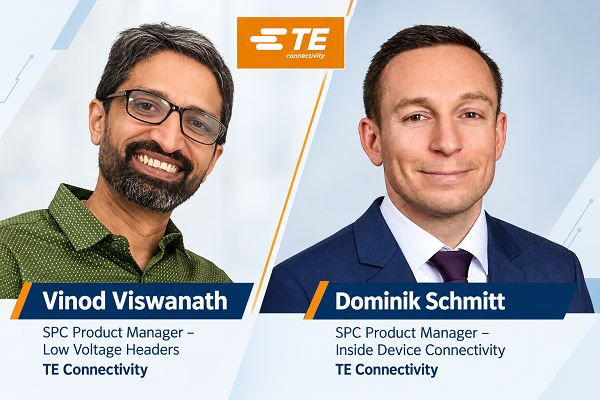

At electronica India 2026, Vaishali Umredkar, Editor of Semiconductor For You, interviewed Vinod Viswanath, SPC Product Manager – Low Voltage Headers, and Dominik Schmitt, SPC Product Manager – Inside Device Connectivity, at TE Connectivity (TE). The discussion focused on how TE Connectivity addresses key industry shifts toward Software-Defined Vehicles (SDVs), centralized zonal architectures, high-speed data transmission, miniaturization, and high-voltage electric vehicle (EV) challenges.
Excerpts from the Interview
Q1. What are the primary connectivity challenges driven by the shift towards software-defined and connected vehicles?
Vinod Viswanath: Vehicle architectures are moving from distributed systems to zonal control units and software-defined vehicles. In software-defined vehicles, standardized and scalable hardware architectures can support multiple vehicle variants, while features and functions can increasingly be added or updated through software.
From a connectivity perspective, this requires connection systems that integrate power, signal, and data into a single, highly flexible footprint. Combining these introduces challenges around data integrity, signal interference, cybersecurity, and backward compatibility to ensure software updates remain compatible across vehicle generations.
Q2. What specific connection systems have been developed to address these evolving requirements?
Dominik Schmitt: Modular hybrid connector systems have been introduced to combine power, signal, and data terminals within a single connector. These systems use configurable inserts across housings ranging from two to eight or ten compartments. They are designed especially for high-performance computers (HPCs) and zonal controllers.
Additionally, specialized inside-device connectivity solutions address internal board-to-board and wire-to-board requirements inside enclosed units, such as zonal control units, HPCs, batteries, battery control systems, and integrated power distribution units (PDUs) and DC-DC converters.
Q3. How is miniaturization achieved without compromising mechanical and electrical reliability in rugged vehicle environments?
Dominik Schmitt: Miniaturization in automotive applications relies on terminal systems such as NanoMQS and PicoMQS, both designed for high-vibration automotive environments. In addition, we feature connectors from other TE business units. Currently, we are promoting a connector series from our Connected Living Solutions business unit: the Signal Grace Inertia terminal, which can be used in applications with lower requirements.
Furthermore, to support dense internal controller layouts, specialized components such as 0.5 mm-pitch floating board-to-board connectors, with up to 120 positions, help absorb mechanical tolerances during assembly in the X/Y and Z directions.
Vinod Viswanath: Reducing terminal pitch, such as transitioning from standard MQS to NanoMQS terminal systems, reduces the PCB footprint. Adopting Surface Mount Technology (SMT) also helps free up underlying circuit layers on multilayer PCBs.
At the system level, smaller headers reduce housing plastic weight, while miniaturized terminals accommodate thinner wire cross-sections, significantly lowering harness weight. Where technically suitable, solutions designed for aluminum conductors can offer additional weight-saving potential.
Q4. How are high-speed data connectivity demands being met as automotive sensor density increases?
Dominik Schmitt: Modern real-time applications, such as adaptive matrix LED headlamps that adjust pixel arrays based on camera, radar, or LiDAR inputs, require bandwidth beyond that offered by legacy CAN networks.
High-speed coaxial or differential data connections are integrated directly into hybrid connector housings alongside standard power and signal lines to manage high-throughput data streams.
Q5. What are the engineering benefits of transitioning to centralized zonal architectures for OEMs?
Vinod Viswanath: Depending on the vehicle architecture, centralized and zonal approaches can significantly reduce the number of control units by consolidating applications and functions into fewer, more powerful central and zonal controllers.
This structural shift can improve overall vehicle efficiency by accommodating more functions in the same or less space, reducing the number of components, and enabling the integration of more sustainable raw materials into connector designs.
Q6. What are the key connectivity and thermal challenges associated with high-voltage EV systems?
Dominik Schmitt: Beyond high-current transmission, high-voltage/low-current sensing inside battery enclosures requires specialized solutions. Connectors featuring wide contact pitches, rated up to [confirm voltage rating], are used to interface directly with Flexible Printed Circuits (FPCs) and Flexible Flat Cables (FFCs) for battery-cell monitoring.
Vinod Viswanath: High-voltage design prioritizes physical safety, incorporating touch-proof interfaces to prevent accidental contact with live components. Thermal simulation modelling is performed before hardware prototyping to map hotspots and integrate connector footprints with vehicle cooling circuits. Integrated shielding helps reduce electromagnetic interference between high-voltage lines and low-voltage signal paths.
Q7. How are global connectivity platforms adapted for the Indian automotive market?
Vinod Viswanath: Product development for India incorporates localized, cost-optimized engineering solutions while maintaining global quality standards. Local engineering and manufacturing ecosystems, including TE’s engineering and manufacturing facilities in Pune, support both domestic OEMs and export platforms.
The technical adoption gap between global markets and India has narrowed, driven by accelerated safety regulations, evolving occupant-safety requirements, expanding ADAS Level 2 deployment, and stringent emission rules.
About TE Connectivity
TE Connectivity plc (NYSE: TEL) is a global industrial technology leader creating a safer, sustainable, productive, and connected future. As a trusted innovation partner, its broad range of connectivity and sensor solutions enables the distribution of power, signal, and data to advance next-generation transportation, energy networks, automated factories, data centers enabling artificial intelligence, and more.
More than 90,000 TE employees, including 10,000 engineers, work alongside customers in approximately 130 countries.
In a world that is racing ahead, TE ensures that EVERY CONNECTION COUNTS.
Learn more at www.te.com and follow TE Connectivity on LinkedIn, Facebook, and Instagram.
Legal Disclaimer
While TE has made every reasonable effort to ensure the accuracy of the information in this presentation, TE does not guarantee that it is error-free, nor does TE make any other representation, warranty, or guarantee that the information is accurate, correct, reliable, or current. TE reserves the right to make adjustments to the information contained herein at any time without notice.
TE Connectivity, TE, the TE Connectivity logo, MQS, NanoMQS, Grace Inertia, and EVERY CONNECTION COUNTS are trademarks owned or licensed by the TE Connectivity plc family of companies. All other logos, products, and company names referred to herein might be trademarks of their respective owners.