

What is OLED Technology?
OLED (Organic Light-Emitting Diode) is a display technology that uses organic compounds to produce light when an electric current passes through them. Unlike conventional LED and LCD displays, OLED displays do not require a separate backlight because each pixel generates its own light. OLED technology is based on the principle of electroluminescence, which is the phenomenon in which a material emits light in response to an electric current. OLED displays offer several advantages, including low power consumption, high contrast, vibrant colours, a wide viewing angle, and a thin, lightweight design.
OLED displays are widely used in televisions, computer monitors, smartphones, digital cameras, smartwatches, and other portable electronic devices. The organic layers used in OLED devices are extremely thin, typically measuring only a few hundred nanometers. OLED technology also supports flexible and transparent displays, making it suitable for modern electronic devices with innovative designs.

Architecture of OLED Technology
The OLED structure consists of several thin layers of organic and inorganic materials placed between two electrodes. When direct current (DC) is supplied, electrons and holes are injected into the organic layers. Their recombination produces visible light through electroluminescence.
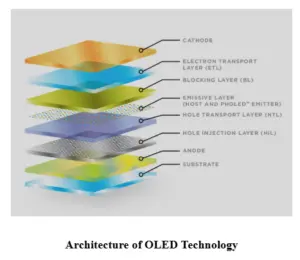
A typical OLED display consists of the following layers:
1. Substrate Layer
The substrate is the base layer that supports the entire OLED structure. It is generally made of glass, transparent plastic, or flexible metal foil. The substrate provides mechanical support and determines whether the OLED display is rigid or flexible.
2. Anode Layer
The anode is the positive electrode of the OLED device. It removes electrons from the organic layers, creating positively charged holes that move towards the emissive layer. Indium tin oxide (ITO) is commonly used as an anode material because it is electrically conductive and transparent, allowing light to pass through the display.
3. Conductive Layer
The conductive layer transports holes from the anode towards the emissive layer. It is made of organic materials that support the movement of positive charge carriers. Common materials used in this layer include polyaniline and poly(3,4-ethylenedioxythiophene), also known as PEDOT.
4. Emissive Layer
The emissive layer is the main light-producing layer of an OLED device. It contains organic molecules or polymers that emit light when electrons and holes recombine within the layer. Different emissive materials are used to produce different colours, including red, green, and blue. By combining these colours, OLED displays can generate a wide range of colour combinations.
5. Cathode Layer
The cathode is the negative electrode of the OLED device. It injects electrons into the organic layers, which then move towards the emissive layer and recombine with holes to produce light. Materials such as aluminium, magnesium, calcium, and their alloys may be used to construct the cathode. Depending on the OLED design, the cathode can be transparent or opaque.
Working Principle of OLED
OLED technology works on the principle of electroluminescence. It converts electrical energy directly into light using organic materials.
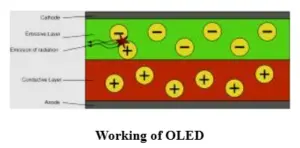
The working of an OLED display can be explained through the following steps:
1. Application of Electrical Voltage
When an electrical voltage is applied across the OLED device, the anode and cathode begin injecting holes and electrons into the organic layers.
2. Movement of Charge Carriers
Holes move from the anode through the conductive layer towards the emissive layer, while electrons move from the cathode towards the emissive layer.
3. Recombination of Electrons and Holes
Electrons and holes meet and recombine within the emissive layer. During this process, energy is released in the form of photons.
4. Emission of Light
The released photons produce visible light. The colour of the emitted light depends on the organic material used in the emissive layer.
By controlling the current supplied to individual OLED pixels, the brightness and colour of the display can be adjusted to produce images and videos.
Types of OLED Technology
OLED technology is classified into different types according to its structure, operation, materials, and display characteristics.
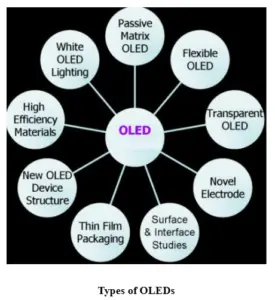
1. Passive Matrix OLED (PMOLED)
Passive Matrix OLED displays consist of organic layers positioned between rows and columns of anode and cathode strips. The pixels are controlled using external circuitry that supplies current to the selected rows and columns. PMOLED displays are relatively simple to manufacture and are suitable for small screens, such as those used in basic mobile phones, smartwatches, and other electronic devices. However, they are generally less suitable for large displays because of their limitations in power efficiency and resolution.
2. Active Matrix OLED (AMOLED)
Active Matrix OLED displays use a thin-film transistor (TFT) array to control individual pixels. Each pixel is controlled by electronic switching circuits that regulate the current supplied to the OLED elements. AMOLED technology offers faster response times, high resolution, improved power efficiency, and better performance for large displays. It is widely used in smartphones, televisions, tablets, and smartwatches.
3. Transparent OLED
Transparent OLED displays are designed using transparent electrodes and substrates, allowing light to pass through the display when it is not emitting light. These displays can produce images while maintaining transparency. Transparent OLEDs are used in heads-up displays, transparent television screens, smart windows, digital signage, and advanced display systems.
4. Top-Emitting OLED
In a top-emitting OLED, light is emitted through the upper electrode rather than through the substrate. The substrate may be reflective, allowing more light to be directed towards the viewing surface. Top-emitting OLED technology is particularly useful in active-matrix displays because it can improve light output and display efficiency.
5. White OLED (WOLED)
White OLED technology produces white light using organic emissive materials. White OLED panels can be used in lighting applications and display systems that combine white OLED emission with colour filters to produce different colours. WOLED technology is used in OLED televisions and lighting panels because it provides uniform illumination, high contrast, and efficient light generation.
6. Flexible OLED
Flexible OLED displays are manufactured using flexible substrates such as plastic or thin metal foil instead of rigid glass. These displays can bend, curve, or fold without breaking under normal design conditions. Flexible OLED technology is used in foldable smartphones, curved displays, wearable devices, and other electronic products with flexible display surfaces.
7. Phosphorescent OLED (PHOLED)
Phosphorescent OLED technology uses phosphorescent materials to improve light-emission efficiency. It can theoretically convert nearly all electrically generated excitons into light, resulting in higher efficiency than conventional fluorescent OLED materials. PHOLED technology is useful in displays and lighting applications where high efficiency, low power consumption, and improved brightness are required.
Advantages of OLED Technology
OLED technology offers several advantages over conventional LCD and LED display systems.
- High contrast ratio: OLED pixels can be switched off completely, producing deep blacks and excellent contrast.
- Low power consumption: OLED displays can consume less power when displaying darker images because individual pixels can be turned off.
- Wide viewing angle: OLED displays maintain good colour accuracy and brightness from different viewing angles.
- Fast response time: OLED technology provides rapid pixel response, making it suitable for gaming and high-speed video.
- Thin and lightweight: OLED displays do not require a separate backlight, allowing them to be thinner and lighter.
- Flexible design: OLED technology supports curved, foldable, and flexible display applications.
- Excellent colour reproduction: OLED displays provide vivid colours and high image quality.
- Environmentally friendly materials: OLED technology does not require mercury, unlike some fluorescent lighting technologies.
Disadvantages of OLED Technology
Despite its advantages, OLED technology also has certain limitations.
- High manufacturing cost: OLED displays can be expensive to manufacture because of complex production processes and material requirements.
- Limited lifespan: Organic materials may degrade over time, especially blue-emitting materials, which can affect brightness and colour performance.
- Burn-in risk: Displaying static images for long periods may cause uneven pixel ageing and permanent image retention.
- Sensitivity to moisture: Organic materials are sensitive to moisture and oxygen, requiring effective encapsulation and protection.
- Brightness limitations: Some OLED displays may have limitations in sustained full-screen brightness compared with certain LCD technologies.
Applications of OLED Display Technology
OLED technology is used in a wide range of electronic devices and lighting systems because of its excellent display quality, flexibility, and energy efficiency.
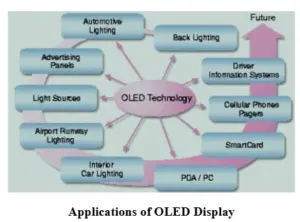
1. OLED Televisions
OLED televisions provide high contrast, deep black levels, vivid colours, and wide viewing angles. Since individual pixels generate their own light, OLED TVs can deliver excellent picture quality without requiring a separate backlight.
2. Smartphones
OLED displays are widely used in smartphones because they are thin, lightweight, power-efficient, and capable of displaying high-resolution images. AMOLED displays are particularly popular in modern mobile devices.
3. Computer Monitors
OLED monitors are used in gaming, professional video editing, graphic design, and other applications that require accurate colours, fast response times, and high contrast.
4. Smartwatches and Wearable Devices
OLED displays are suitable for wearable devices because they are lightweight, consume relatively little power, and provide clear visibility on compact screens.
5. Digital Cameras
OLED technology is used in electronic viewfinders and display screens of digital cameras to provide high-quality images with excellent contrast and colour reproduction.
6. OLED Lighting
OLED lighting panels produce uniform light over a large surface area. They can be designed as thin, flexible, and transparent lighting panels for decorative, architectural, and commercial lighting applications.
7. OLED Keyboards
OLED technology can be incorporated into programmable keyboards. Individual keys or small display panels can show icons, shortcuts, application controls, and other information depending on the user’s requirements.
8. Flexible and Foldable Displays
Flexible OLED technology is used in foldable smartphones, curved display panels, rollable screens, and other innovative electronic devices. Its flexibility allows manufacturers to develop compact and versatile display designs.
Conclusion
OLED technology is an advanced display technology that uses organic materials to generate light through electroluminescence. Its thin structure, high contrast ratio, excellent colour reproduction, fast response time, and flexible design make it suitable for a wide range of electronic devices. OLED displays are widely used in smartphones, televisions, computer monitors, wearable devices, digital cameras, and lighting systems. With continuous improvements in manufacturing techniques, efficiency, durability, and flexible display designs, OLED technology is expected to play an important role in the future of electronic displays.