
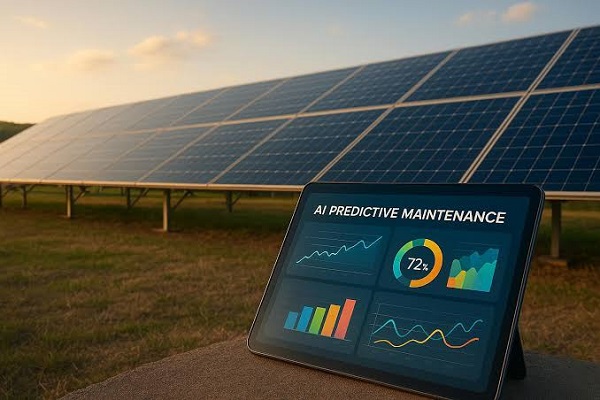
Solar panels can deliver clean and renewable energy for many years, but their performance gradually decreases when dust, dirt, pollen and other airborne particles accumulate on their surface. This problem is particularly significant in regions with high dust levels, where solar modules may require frequent cleaning to maintain optimum energy generation.

Conventional solar-panel maintenance generally follows a fixed cleaning schedule. However, cleaning too frequently increases water, labour and maintenance costs, while delaying cleaning can result in unnecessary energy losses. A smarter approach is to determine when a panel actually needs cleaning based on its operating condition.
SolarSense AI is an intelligent predictive-maintenance system that continuously monitors solar-panel performance and environmental conditions. The system uses an ESP32-WROOM-32 as its central controller to collect data from multiple sensors, calculate the panel’s electrical output and analyse changes in performance.
The system combines parameters such as solar irradiance, panel temperature, humidity, dust concentration, voltage and current. An Edge AI/ML algorithm analyses these parameters to estimate the level of dust accumulation, calculate potential power loss and recommend an optimum cleaning schedule.
The ESP32-WROOM-32 is particularly suitable for this project because it combines microcontroller processing with built-in Wi-Fi and Bluetooth connectivity, allowing the prototype to operate as both an Edge AI monitoring device and an IoT-enabled solar-monitoring system.
System Architecture
The basic architecture of SolarSense AI is:
Solar Panel → Voltage & Current Sensors → ESP32-WROOM-32 → Edge AI Analysis → Cleaning Recommendation
Environmental sensors provide additional information:
Light/Irradiance + Panel Temperature + Ambient Temperature/Humidity + Dust → ESP32-WROOM-32
The controller processes the sensor readings and compares the actual solar output with the expected output under the measured environmental conditions.
The system can provide outputs such as:
- Solar-panel voltage
- Solar-panel current
- Generated power
- Solar irradiance
- Panel temperature
- Ambient temperature and humidity
- Dust concentration
- Estimated power loss
- Soiling index
- Cleaning recommendation
The ESP32 can also transmit selected data over Wi-Fi to a web dashboard or mobile application for remote monitoring.
Components Used
| Component | Suggested Part / Module | Function |
| Main Controller | ESP32-WROOM-32 Development Board | Sensor acquisition, processing, Edge AI/ML inference and wireless connectivity |
| Solar Panel | 6V/12V Mini Solar PV Panel | Provides the monitored solar power source |
| Current Sensor | ACS712-05B | Measures solar-panel output current |
| Voltage Measurement | Resistor Voltage Divider | Scales panel voltage to a suitable ADC input |
| Light/Irradiance Sensor | BH1750FVI | Measures incident light intensity |
| Panel Temperature Sensor | DS18B20 | Measures solar-panel temperature |
| Ambient Sensor | BME280 | Measures ambient temperature and humidity |
| Dust Sensor | SDS011 | Measures particulate/dust concentration |
| Display | 0.96-inch SSD1306 OLED | Displays real-time panel and cleaning information |
| Data Storage | MicroSD Card Module | Stores historical sensor readings |
| Alert | LED + Active Buzzer | Indicates when cleaning is recommended |
| Power Supply | LM2596 DC-DC Buck Converter | Provides regulated supply voltage |
| Connectivity | ESP32-WROOM-32 built-in Wi-Fi/Bluetooth | Enables remote monitoring and data transmission |
| Prototype Platform | Breadboard / Custom PCB | Hardware interconnection |
Circuit Design
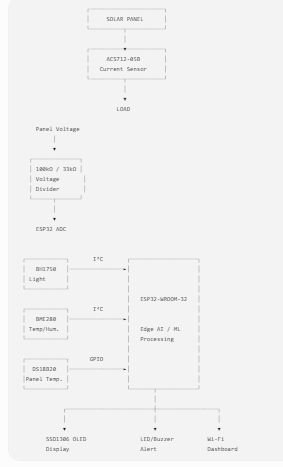
The ESP32-WROOM-32 acts as the central controller of the system. Different sensors are connected to its digital, analog and I²C interfaces.
The ACS712 current sensor is connected in series with the solar-panel output. It generates a voltage corresponding to the current flowing through the panel. The ESP32 reads this signal through an ADC input.
Panel voltage is measured using a resistor-divider circuit. For example, two appropriately selected resistors can reduce the solar-panel voltage to a level within the ESP32 ADC input range.
The controller calculates instantaneous electrical power using:
P = V × I
where:
- P = Solar-panel power
- V = Panel voltage
- I = Panel current
A BH1750 light sensor is connected through the I²C interface to measure ambient light intensity. This measurement is essential because solar-panel output naturally changes with sunlight. A reduction in power during cloudy conditions should not be incorrectly classified as dust-related power loss.
A DS18B20 temperature sensor is mounted close to the solar-panel surface to measure its operating temperature. A BME280 measures ambient temperature and humidity.
The SDS011 dust sensor provides particulate concentration data. Although atmospheric dust concentration does not directly measure the amount of dust deposited on a panel, it provides valuable supporting information for the predictive algorithm.
The SSD1306 OLED display can be connected using I²C and used to display real-time information.
A simplified connection arrangement is:
Solar Panel → ACS712 → Load
Solar Panel → Voltage Divider → ESP32 ADC
BH1750 → I²C → ESP32
BME280 → I²C → ESP32
DS18B20 → GPIO → ESP32
SDS011 → UART → ESP32
SSD1306 OLED → I²C → ESP32
ESP32 → Wi-Fi → Cloud/Web Dashboard
The circuit should include appropriate voltage regulation and signal conditioning, and all sensor grounds should share a suitable common reference.
Working Principle
When the system starts, the ESP32-WROOM-32 begins collecting sensor readings at regular intervals. The measured voltage and current are used to determine the actual power generated by the panel.
At the same time, the system records irradiance, temperature, humidity and dust-related data.
The AI algorithm establishes an expected power level based on the environmental conditions. For example, under strong sunlight and normal operating temperature, a clean panel should generate a particular amount of power.
If the actual power is significantly lower than the expected power for a sustained period, the system identifies a possible soiling condition.
For example:
Expected power = 420 W
Actual power = 360 W
Estimated power loss = 60 W
The algorithm does not immediately assume that the 60 W loss is caused by dust. It considers other factors such as reduced irradiance, high panel temperature, changing weather and historical measurements.
This makes the system more reliable than a simple threshold-based dust alarm.
Edge AI-Based Prediction
The key feature of SolarSense AI is its ability to move from simple monitoring to predictive maintenance.
A machine-learning model can be trained using data collected from solar panels under different conditions, including clean panels and panels with progressively increasing levels of dust accumulation.
Potential input features include:
Irradiance + Panel Temperature + Ambient Temperature + Humidity + Dust Level + Voltage + Current + Historical Power
The model can generate outputs such as:
Soiling Index: 78%
Estimated Power Loss: 12%
Cleaning Recommendation: Required Soon
A lightweight regression, decision-tree or other embedded-friendly ML model can be used for the prototype. The trained model can then be deployed on the ESP32 so that inference takes place locally.
This Edge AI approach reduces dependence on continuous cloud processing and allows the system to make decisions even when internet connectivity is unavailable.
Wi-Fi-Based Monitoring
The ESP32-WROOM-32’s built-in Wi-Fi capability adds an important IoT feature to SolarSense AI.
The controller can periodically transmit processed information to a local or cloud-based dashboard. A user could remotely monitor:
- Current solar power
- Daily energy generation
- Panel temperature
- Environmental conditions
- Estimated soiling level
- Predicted power loss
- Cleaning status
For a larger deployment, multiple SolarSense AI nodes could be installed across different solar panels or sections of a solar farm.
Cleaning Recommendation
Rather than generating an alert whenever power decreases, SolarSense AI can use a combination of soiling level, predicted power loss and historical trends to determine whether cleaning is worthwhile.
For example:
Soiling Index < 30%: No cleaning required
Soiling Index 30–60%: Monitor condition
Soiling Index 60–80%: Cleaning recommended
Soiling Index > 80%: Clean panel soon
These values are illustrative and should be calibrated using real-world data from the target solar installation.
The system could ultimately predict a statement such as:
“Cleaning recommended within the next 48 hours to minimise energy loss.”
Conclusion
SolarSense AI demonstrates how an inexpensive IoT microcontroller can be combined with Edge AI and environmental sensing to create a smart solar-panel maintenance system.
The ESP32-WROOM-32 provides an effective alternative to specialised development platforms because it offers sufficient processing capability for a prototype, multiple communication interfaces and built-in Wi-Fi/Bluetooth connectivity.
By monitoring electrical and environmental parameters simultaneously, SolarSense AI can move beyond conventional fixed cleaning schedules and introduce condition-based predictive maintenance.
The concept can be further developed by adding more advanced machine-learning models, dedicated solar irradiance sensors, panel-level energy meters, automated cleaning mechanisms and cloud-based analytics. With sufficient field data, the system could help solar operators reduce unnecessary cleaning, identify performance degradation earlier and maximise the energy yield of photovoltaic installations.