
Introduction
The Synchronous Reluctance Motor (SynRM) is a type of synchronous electric motor that operates based on the principle of magnetic reluctance. Unlike conventional motors, it does not require permanent magnets or rotor windings. Due to its simple construction, high efficiency, and low maintenance requirements, this motor is becoming increasingly popular in industrial applications, hybrid vehicles, and electric vehicles.
A reluctance motor uses a ferromagnetic rotor that develops non-permanent magnetic poles without requiring rotor windings. The rotor produces torque through the principle of magnetic reluctance. Various types of reluctance motors are available, including synchronous reluctance motors, switched reluctance motors, variable reluctance motors, and variable stepping reluctance motors. Initially, reluctance motors had limited applications due to difficulties in design and operation. However, advancements in motor design, control theory, embedded systems, and power electronics have significantly increased their adoption in modern applications.

What is a Synchronous Reluctance Motor?
A Synchronous Reluctance Motor (SynRM) is a synchronous AC motor that does not contain field windings or permanent magnets. It generates torque due to the difference in magnetic reluctance between the direct axis (d-axis) and quadrature axis (q-axis) of the rotor.
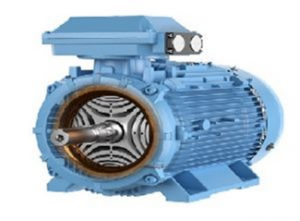
Due to its robust construction and high efficiency, the synchronous reluctance motor has become an attractive option for industrial drives, hybrid vehicles, and electric vehicles. One of its major advantages is the absence of rotor cage losses, which enables it to provide higher torque than an induction motor of the same size.
Features of Synchronous Reluctance Motor
- The field-oriented control algorithm is simpler compared to induction motor drives.
- Precise torque control can be achieved without affecting rotor temperature.
- The rotor is less expensive than induction and permanent magnet motors.
- It offers high efficiency and low maintenance.
- The motor has a rugged and reliable construction.
- It can operate efficiently at high speeds.
Synchronous Reluctance Motor Construction
The construction of a synchronous reluctance motor is similar to that of a salient-pole synchronous motor. The stator contains a three-phase symmetrical winding, while the rotor does not have field windings or permanent magnets. The stator winding produces a sinusoidal rotating magnetic field across the air gap.
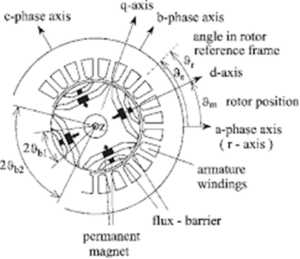
The rotor aligns itself with the position of minimum magnetic reluctance, thereby generating reluctance torque. Modern synchronous reluctance motor rotors are constructed using iron laminations separated by non-magnetic materials. This design improves performance while maintaining a simple and robust structure.
Types of Rotor Construction
- Axially Laminated Rotor
- Radially Laminated Rotor
The stator of the motor consists of prominent electromagnet poles similar to those used in brushless DC (BLDC) motors. The rotor is generally made from laminated silicon steel and contains projections that act as magnetic poles with varying reluctance. The number of rotor poles is usually lower than the number of stator poles, which helps reduce torque ripple and prevents complete pole alignment. When a rotor pole is positioned between two adjacent stator poles, the magnetic reluctance is maximum. As the stator magnetic field rotates, the rotor moves toward the position of minimum reluctance, thereby producing torque. Most modern reluctance motors use electronic commutation techniques, which provide smooth operation, efficient speed control, and reliable starting performance.
Synchronous Reluctance Motor Working Principle
The working principle of a synchronous reluctance motor is based on the tendency of the rotor to align itself with the path of minimum magnetic reluctance. The stator contains a main winding and an auxiliary winding. The auxiliary winding is connected in series with a capacitor to create a phase difference between the currents flowing through the windings. This phase difference generates a rotating magnetic field inside the stator. The speed of this magnetic field is known as synchronous speed and depends upon the number of stator poles.
Initially, the rotor behaves similarly to a squirrel-cage induction motor rotor and accelerates close to synchronous speed. Once the rotor reaches near-synchronous speed, it locks magnetically with the rotating magnetic field and continues rotating at synchronous speed. The rotor continuously attempts to align itself with the minimum reluctance path created by the stator magnetic field. This phenomenon generates reluctance torque and enables the motor to operate as a synchronous motor. For stable operation, the load torque, rotor inertia, and rotor resistance should remain relatively low.
Advantages of Synchronous Reluctance Motor
- Low torque ripple.
- Rotor construction uses low-cost and high-strength materials.
- Compatible with standard PWM AC inverters.
- Can operate efficiently at very high temperatures.
- Simple and rugged construction.
- High-speed operating capability.
- No field excitation losses at zero torque.
- No risk of demagnetization.
- More reliable than permanent magnet motors.
- Suitable for multi-motor synchronous drive systems.
- High efficiency with low maintenance requirements.
Disadvantages of Synchronous Reluctance Motor
- More expensive than conventional induction motors.
- Requires synchronization with inverter output frequency.
- Needs rotor position sensors or advanced sensorless control techniques.
- Lower power factor compared to induction motors.
- Generally heavier than induction motors.
- Requires a variable frequency drive (VFD) for operation.
Applications of Synchronous Reluctance Motor
- Fibre spinning mills.
- Timing devices.
- Phonographs.
- Control equipment.
- Recording instruments.
- Pumps and conveyor systems.
- Metering pumps.
- Synchronized conveyor systems.
- Turntables and regulators.
- Synthetic fibre manufacturing equipment.
- Film production machinery.
- Folding and wrapping machines.
- Industrial automation systems.
- Hybrid and electric vehicles.
Conclusion
The synchronous reluctance motor is an efficient and reliable electric motor that operates without permanent magnets or rotor windings. Its simple construction, high efficiency, excellent thermal performance, and low maintenance requirements make it an attractive alternative to induction and permanent magnet motors. With advances in power electronics and control technologies, synchronous reluctance motors are increasingly being adopted in industrial automation, electric vehicles, and high-performance drive systems.