

Beyond the Robot Brain
How Semiconductors Are Giving Machines the Power to See, Feel, Think and Act

The next great computing platform may not sit on a desk, in a data centre or inside a smartphone. It may walk into a factory, navigate a warehouse, assist a healthcare worker, inspect infrastructure—or simply work alongside a human.
Robotics is entering the era of Physical AI, where intelligence moves beyond digital environments and becomes capable of interacting with the physical world. Humanoids, collaborative robots, autonomous mobile robots and intelligent industrial machines are moving from controlled demonstrations toward increasingly sophisticated real-world applications.
Yet the path from an impressive prototype to a dependable commercial machine will not be determined by artificial intelligence alone. Beneath every intelligent movement lies an intricate semiconductor architecture—processors, MCUs, AI accelerators, sensors, motor-control ICs, power devices, connectivity and security technologies working together in real time.
As Nenad Belancic, Head of Global Application Management Robotics at Infineon Technologies, puts it, “The intelligence lives in the AI model, but it doesn’t reach the physical world without the electronics underneath it.” A high-end humanoid with advanced vision and zonal control can contain several thousand semiconductors spanning compute and control, connectivity, sensing, motor control and power management.
That makes the robotics revolution, fundamentally, a semiconductor revolution.
Industry Voices: The Future of Robotics
Perspectives from industry leaders on the semiconductor technologies shaping Physical AI.
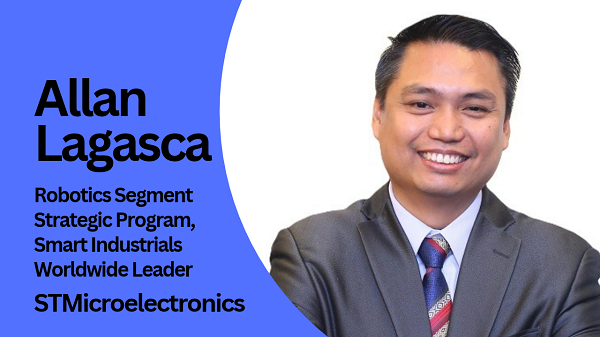
Allan Lagasca
Robotics Segment Strategic Program, Smart Industrials Worldwide Leader, STMicroelectronics
“The next robotics era will replace the single central brain with distributed, trusted intelligence embedded across perception, joints, hands, power and safety—enabling Physical AI to act locally and safely.”
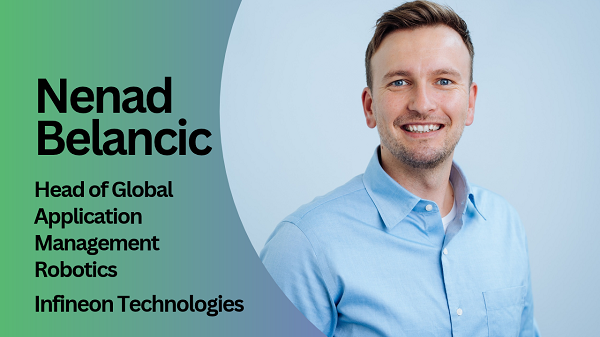
Nenad Belancic
Head of Global Application Management Robotics, Infineon Technologies
“The future of robotics lies in architectural convergence—where sensing, connectivity, safety, security, motor control and power intelligence work together across every joint to enable scalable humanoids.”

Julien Ghaye
Product Line Manager Robotics, Melexis
“Robots must move beyond seeing to truly feeling. Distributed physical sensing, combining tactile, position and thermal intelligence with local processing, will unlock the dexterity required for everyday human environments.”

Viswa Mohan Y
General Manager – Strategic Planning, Mitsubishi Electric India
“Robotics is evolving into intelligent automation ecosystems, where edge AI, sensing, control, connectivity and power technologies converge with digital twins to create adaptive, continuously optimised industrial systems.”

Joseph Bousaba
CEO, InvenSense, a TDK Group company
“Robotics will advance through smarter sensing and decentralised edge intelligence, combining MEMS, sensor fusion, compute and emerging neuromorphic architectures to deliver lower latency, greater accuracy and improved power efficiency.”
From automation to Physical AI
The robotics market is approaching a significant inflection point. Infineon cites projections of more than 22% growth for the overall robotics market, potentially reaching up to 100 million units by 2030, with humanoids among the fastest-growing segments. Ageing populations, labour shortages, rising labour costs and the expansion of AI and IoT into physical environments are among the forces driving this momentum.
But the next three to five years will be less about simply putting more robots into factories and more about changing what those robots can do.
Allan Lagasca, Robotics Segment Strategic Program, Smart Industrials Worldwide Leader at STMicroelectronics, sees robotics—particularly humanoids—moving from automation pilots toward scalable Physical AI systems across factories, warehouses, healthcare environments, infrastructure and autonomous fleets. In his view, the decisive change is the movement of intelligence into the machine through distributed sensing, edge processing, motion control and power management.
Viswa Mohan Y, General Manager – Strategic Planning at Mitsubishi Electric India, similarly expects robots to evolve from standalone automated machines into intelligent, interconnected and adaptive components of integrated automation ecosystems. Motion control, machine vision, sensing, AI and connectivity will increasingly operate as one system, driving demand for high-performance MCUs, processors, AI accelerators, image sensors and power components.
This evolution could have a particularly significant impact on high-mix manufacturing, where flexible automation can improve productivity, quality and energy efficiency.
The factory of the future, therefore, will not simply contain more robots. It will contain robotic systems that understand their surroundings and continuously adapt to them.
The intelligence moves to the edge
For a robot, intelligence has a different meaning from intelligence in the cloud.
A cloud-based AI system can afford to spend time processing information. A robot cannot always wait. When a robotic hand senses an object slipping, when a mobile robot detects an obstacle or when a humanoid begins losing its balance, the response has to happen immediately.
“Robots are trained in the data center, but real-time decision making needs to happen on device,” says Infineon’s Belancic.
This is creating a fundamental architectural shift toward distributed edge intelligence.
In a humanoid, the requirement becomes particularly demanding. Infineon points out that a system with more than 70 joints can require local processing at each joint for position sensing, current sensing and motor control, rather than depending on a central compute unit for every micro-decision. Microcontrollers can also operate as independent safety companions to central compute, monitoring the robot and enabling safe behaviour locally.
ST’s Allan Lagasca describes the same transition as a perception-to-action loop. Low-power edge AI processors, spatial vision, MEMS, ToF sensing, current sensing and sensor fusion bring perception and inference closer to the point of action. ST’s architecture combines sensing with STM32 and STM32MP real-time control platforms and STM32N6 edge processing with neural acceleration.
The objective is not merely faster computation. It is lower cloud dependence, reduced bandwidth requirements, faster response and safer autonomy.
Seeing is no longer enough: robots must feel
Perhaps the most important frontier in Physical AI is not vision—it is touch.
Today’s AI systems can recognise objects with extraordinary accuracy. But recognising an object is different from knowing how hard to grip it, whether it is slipping, what texture it has or how much force is being applied.
Julien Ghaye, Product Line Manager Robotics at Melexis, identifies this as one of the central challenges facing physical AI. Vision chips and edge NPUs are highly capable of macro-level spatial perception, but they do not solve the problem of physical touch and dexterity. Tactile feedback and high-precision position information are essential for closing that gap.
Melexis is looking toward integrated sensing technologies capable of delivering this information directly where interaction occurs. Ghaye highlights solutions such as Tactaxis®, which captures 3D force vectors at the contact point, alongside magnetic and inductive position sensing that can deliver deterministic, low-latency data at the edge.
Infineon’s Belancic also identifies tactile sensing as decisive for humanoid deployment. Dexterous hands need to sense pressure, texture, slip and contact force in real time, particularly when robots work alongside people.
This points toward an important future development: the robot will increasingly sense its environment through its entire body, not simply through cameras mounted on its head.
Every joint becomes an intelligent system
The joint could become the new edge.
Humanoids pack dozens of actuators into compact mechanical structures. Each actuator requires power, sensing, control and thermal management. That makes integration critical.
“Latency and thermal dissipation are mainly a motor control question at the joint,” Belancic explains, noting that with 70 or more joints, motor-control solutions need to be compact, fast and capable of running cool.
Melexis approaches the challenge from the sensing and actuation side. Ghaye notes that integrated motor drivers paired with coreless current sensors can monitor power and heat directly at the joint without adding bulky heat sinks. On-chip calibration and magnetic position sensors capable of operating across wide air gaps can also allow electronics to fit into warm, tightly packed joint assemblies.
ST is pursuing a similar systems approach, combining real-time STM32 control with STSPIN and STDRIVE motor-control technologies, current sensing, protection and power-management technologies.
The result could be a new class of robotic architecture in which every joint is effectively a miniature intelligent node—capable of sensing, processing and acting locally while remaining connected to the robot’s higher-level intelligence.
Power: the hidden battle for autonomy
AI may be the most visible part of a robot, but power could determine whether that intelligence is commercially useful.
A humanoid must carry its energy source. Autonomous mobile robots must maximise operating time. Every inefficient conversion creates heat and consumes valuable battery capacity.
Mitsubishi Electric’s Viswa Mohan points out that semiconductor performance in robotics is no longer simply about computing power. Power consumption, heat generation, latency and system size are equally important as robots become more autonomous and mobile.
Wide-bandgap technologies such as GaN and SiC are becoming important in this equation. Mitsubishi highlights their higher switching frequencies, lower losses and greater power density compared with conventional silicon technologies. More efficient power conversion can improve battery life, reduce system size and increase reliability.
Infineon’s Belancic similarly describes energy efficiency as fundamentally a power-semiconductor challenge and highlights GaN where higher power density and efficiency in a smaller footprint are advantageous, including at the joint level.
For ST’s Allan Lagasca, GaN is particularly relevant to high-density joints and hands, where fast switching, compact form factor and thermal efficiency matter, while SiC supports higher-power conversion and resilient energy delivery.
The message across the industry is consistent: power efficiency is not an isolated component specification—it is a system-level requirement that determines how long, how fast and how safely a robot can operate.
From prototypes to products
The robotics industry has already demonstrated that it can build impressive machines. The harder challenge is building millions of reliable ones.
Joseph Bousaba, CEO of InvenSense, a TDK Group company, brings an important dose of realism to the conversation. While humanoid growth forecasts are substantial—Yole, for example, estimates a $51 billion market by 2035—he points to the frequent failures seen in early humanoid demonstrations as evidence that reliability, performance and safety must become central priorities.
For TDK and InvenSense, this means pushing edge AI capabilities in sensing so humanoids can make decisions and take actions with low latency, high reliability and safety, while minimising power consumption. Bousaba also emphasises that sensing accuracy will remain a major driver of robotics and autonomous-fleet development, building on safety lessons from industrial and automotive sensing.
That reliability requirement changes the semiconductor design equation.
The winning robot will not necessarily be the one with the largest processor. It will be the one where sensors, processors, controllers, power devices and software operate reliably together under real-world conditions.
India’s moment in the robotics race
India’s semiconductor design strength gives it an important starting point in the Physical AI race—but the opportunity extends beyond chip design.
Melexis’ Julien Ghaye notes that India currently trails leading robotics markets, with significant strengths in software and chip design but comparatively less depth in physical mechatronics and hardware manufacturing. Yet he sees the country’s scale and domestic automation requirements as an opportunity to develop low-cost, ruggedised robotics for emerging markets.
For India, this could mean turning real-world challenges into a competitive advantage.
Manufacturing, logistics, infrastructure and other sectors can become proving grounds for robotics designed around affordability, reliability and harsh operating conditions. With targeted support for hardware R&D, local prototyping and mechatronics education, India’s semiconductor talent could increasingly connect with physical-system innovation.
The country’s opportunity, therefore, is not merely to participate in the global robotics market as a consumer. It is to become a contributor to the hardware, silicon and system architectures that make robotics scalable.
The next decade: distributed, trusted and increasingly autonomous
The most profound change ahead may be the disappearance of the traditional idea of a robot having one central “brain.”
ST’s Allan Lagasca expects the next decade to bring a shift from centralised robot intelligence to distributed, trusted intelligence embedded throughout the machine. Semiconductor nodes will increasingly coordinate across perception, joints, hands, power systems, communications and safety layers.
Mitsubishi Electric sees a parallel evolution toward heterogeneous and edge-based architectures in which AI computation, sensing, control, connectivity and power management become increasingly integrated. It also anticipates deeper convergence between semiconductor innovation, digital twins and software-defined automation, enabling robotic and production systems to be simulated, optimised and continuously improved.
Infineon sees architectural convergence extending further, with sensing, connectivity, safety and security moving from discrete systems into integrated architectures. It also highlights Ethernet as an increasingly important in-robot connectivity backbone and hardware-based security designed for future threats, including the post-quantum era.
TDK’s Joseph Bousaba takes the vision even further, pointing toward neuromorphic edge computing, where computation becomes increasingly decentralised and event-driven. Combined with more capable sensing and sensor-fusion software, this could deliver improvements in accuracy, latency and power efficiency for mobile autonomous systems and humanoids. He also anticipates greater integration between edge compute, memory and sensing to improve cost efficiency and commercial scalability.
Melexis predicts a similar future through what it calls Distributed Physical Sensing: multimodal sensing embedded directly into silicon at joints and contact points, combining position, tactile and thermal sensing with signal processing.
Together, these perspectives reveal the architecture of the machine that is coming.
It will see through advanced imaging and spatial sensing. It will feel through tactile and force sensors. It will think locally through edge AI. It will move through intelligent motor-control systems. It will manage its energy through increasingly efficient power semiconductors. It will communicate through high-speed industrial networks. And it will protect its identity and operations through hardware-based security.
The future robot will therefore not be a machine with one powerful brain.
It will be a network of intelligent semiconductor nodes functioning as one physical organism.
That may ultimately be the defining transition of the robotics revolution: AI is learning how to leave the screen and enter the physical world.
And semiconductors are giving it the senses, reflexes, muscles, energy efficiency and trusted infrastructure to do so.
The age of intelligent machines is no longer approaching. It is being engineered—one sensor, processor, power device and intelligent joint at a time.