Semiconductor for You
  • Home
  • Semiconductor News
  • Semiconductor Magazine
  • Technology
    • Automotive
    • Consumer Electronics
    • IoT
    • Test and Measurement
    • Lighting
    • Power Management
    • Wireless
    • Personal Electronics
    • Hardware & Software
    • Research
    • Medical Electronics
    • Embedded Design
    • Aerospace & Defence
    • Artificial Intelligence
  • Interview
  • Industries
  • Market
  • Knowledge Base
  • Events
  • Tools
    • Resistor Color Code Calculator
No Result
View All Result
  • Home
  • Semiconductor News
  • Semiconductor Magazine
  • Technology
    • Automotive
    • Consumer Electronics
    • IoT
    • Test and Measurement
    • Lighting
    • Power Management
    • Wireless
    • Personal Electronics
    • Hardware & Software
    • Research
    • Medical Electronics
    • Embedded Design
    • Aerospace & Defence
    • Artificial Intelligence
  • Interview
  • Industries
  • Market
  • Knowledge Base
  • Events
  • Tools
    • Resistor Color Code Calculator
No Result
View All Result
Semiconductor for You
No Result
View All Result
Home Semiconductor News

Vishay Intertechnology Short Distance Proximity Sensor Offers Idle Current Down to 5 μA and 14-Bit Resolution in Compact Package

Semiconductor For You by Semiconductor For You
August 18, 2026
in Semiconductor News, Sensors
0
ADVERTISEMENT

Featuring a VCSEL and Smart Dual I²C Slave Address, Space-Saving Device Is Ideal for Battery-Powered Consumer Applications, Including TWS Earphones and VR / AR Headsets
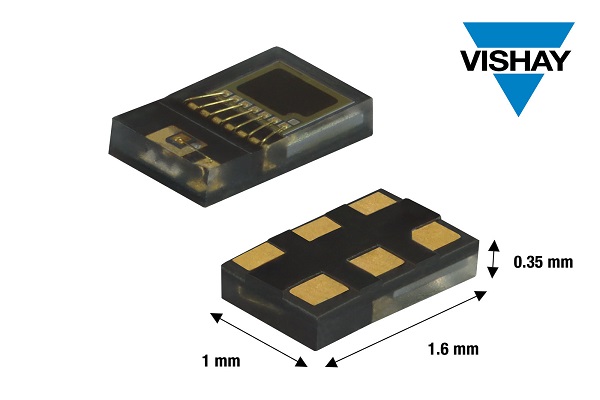
MALVERN, Pa. — Aug. 18, 2026 — The Optoelectronics group of Vishay Intertechnology, Inc. (NYSE: VSH) today introduced a new fully integrated short distance proximity sensor designed to increase efficiency, design flexibility, and performance in consumer applications. Featuring a vertical-cavity surface-emitting laser (VCSEL), the Vishay Semiconductors VCNL36829UM combines a photodiode, application-specific integrated circuit (ASIC), 16-bit ADC, and smart dual I²C slave address in a compact 1.6 mm x 1.0 mm x 0.35 mm transparent mold package with an isolation wall design.

ADVERTISEMENT

Compared to previous-generation solutions, the proximity sensor released today offers a 44 % smaller volume, higher proximity resolution of 14 bits, and stronger sunlight immunity up to 200 klx. Combined with a range of 50 mm, low idle current of 5 μA, and a typical rated supply voltage of 1.8 V, the VCNL36829UM delivers superior proximity detection while reducing power consumption to increase efficiency in space-constrained, battery-powered applications.

The sensor is designed to detect if users are wearing or not wearing smart wearable devices, including true wireless stereo (TWS) earphones, virtual reality / augmented reality (VR / AR) headsets, and smart glasses. It is also suitable for touchless dispensing and lid-off detection in consumer appliances. To lower costs in these applications, the device’s smart dual I²C slave address allows for the connection of two proximity sensors without the need for a multiplexer.

The VCNL36829UM offers a programmable interrupt function that allows designers to specify high and low thresholds, reducing continuous communication with the microcontroller and lowering system power consumption. The sensor’s isolation wall design delivers excellent crosstalk immunity. The device uses intelligent cancellation to further reduce crosstalk, while a smart persistence scheme ensures accurate sensing and faster response time. The VCSEL wavelength peaks at 940 nm and has no visible “red-tail.” The sensor is RoHS-compliant, halogen-free, and Vishay Green.

Device Specification Table:

Part number VCNL36829UM
Function PS + VCSEL
Package size (mm) 1.6 x 1.0 x 0.35
Supply voltage (V) 1.65 to 2.0
I²C bus voltage (V) 1.08 to 3.6
Max. VCSEL driving current (mA) 18
Operating range (mm) 50
Supply current, idle state (μA) 5

Samples and production quantities of the VCNL36829UM are available now, with lead times of 15 weeks.

 

Tags: Proximity SensorVishay
Semiconductor For You

Semiconductor For You

Browse by Category

  • Aerospace and Defence
  • AI & Data Center
  • Articles
  • Automation
  • Automotive
  • Communication
  • Consumer-Electronics
  • Design & Manufacturing
  • Hardware & Software
  • Healthcare
  • Industrial Electronics
  • Interview
  • IoT
  • Knowledge Base
  • Lighting
  • Market
  • personal-electronics
  • Power Management
  • Research
  • Robotics
  • Semiconductor Events
  • Semiconductor News
  • Sensors
  • Technology
  • Test and Measurement
  • Uncategorized
  • Wireless
Semiconductor For You

Semiconductor For You is a resource hub for electronics engineers and industrialist. With its blend of
technology features, news and new product information, Semiconductor For You keeps designers and
managers up to date with the fastest moving industry in the world.

Follow Us

Browse by Category

  • Aerospace and Defence
  • AI & Data Center
  • Articles
  • Automation
  • Automotive
  • Communication
  • Consumer-Electronics
  • Design & Manufacturing
  • Hardware & Software
  • Healthcare
  • Industrial Electronics
  • Interview
  • IoT
  • Knowledge Base
  • Lighting
  • Market
  • personal-electronics
  • Power Management
  • Research
  • Robotics
  • Semiconductor Events
  • Semiconductor News
  • Sensors
  • Technology
  • Test and Measurement
  • Uncategorized
  • Wireless

Recent News

TDK acquires assets from OQmented to advance AR display technologies

August 18, 2026
Vishay Intertechnology Short Distance Proximity Sensor Offers Idle Current Down to 5 μA and 14-Bit Resolution in Compact Package

Vishay Intertechnology Short Distance Proximity Sensor Offers Idle Current Down to 5 μA and 14-Bit Resolution in Compact Package

August 18, 2026
  • About
  • Advertise
  • Privacy & Policy
  • Contact

© 2026 Semiconductor For You

No Result
View All Result
  • Home
  • Semiconductor News
  • Technology
    • IoT
    • Wireless
    • Power Management
    • Automotive
    • Hardware & Software
  • Market
  • Interview
  • Knowledge Base
  • Tools
    • Resistor Color Code Calculator

© 2026 Semiconductor For You