Semiconductor for You
  • Home
  • Semiconductor News
  • Semiconductor Magazine
  • Technology
    • Automotive
    • Consumer Electronics
    • IoT
    • Test and Measurement
    • Lighting
    • Power Management
    • Wireless
    • Personal Electronics
    • Hardware & Software
    • Research
    • Medical Electronics
    • Embedded Design
    • Aerospace & Defence
    • Artificial Intelligence
  • Interview
  • Industries
  • Market
  • Knowledge Base
  • Events
  • Tools
    • Resistor Color Code Calculator
No Result
View All Result
  • Home
  • Semiconductor News
  • Semiconductor Magazine
  • Technology
    • Automotive
    • Consumer Electronics
    • IoT
    • Test and Measurement
    • Lighting
    • Power Management
    • Wireless
    • Personal Electronics
    • Hardware & Software
    • Research
    • Medical Electronics
    • Embedded Design
    • Aerospace & Defence
    • Artificial Intelligence
  • Interview
  • Industries
  • Market
  • Knowledge Base
  • Events
  • Tools
    • Resistor Color Code Calculator
No Result
View All Result
Semiconductor for You
No Result
View All Result
Home Articles

Wire wound potentiometer

Semiconductor For You by Semiconductor For You
May 29, 2021
in Articles
0

Construction:

Wire wound potentiometer

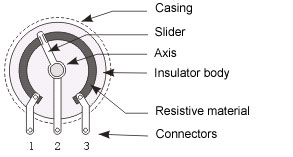
Above fig shows the constructional diagram of wire wound potentiometer. The basic construction of wire wound potentiometer is made of nichrome wire wound on a doughnut-shaped core of bracket and enclosed with an insulating coating.

A window is left in the insulating cover, which exposes the resistive wire. There is rotating shaft at the center of the core. The shaft moves an arm and a contact point from end to end of the resistance element.

The diameter of a body can range from less than an inch or more. There are three terminals coming out of a potentiometer. The outer two terminals are the two end points of the resistances elements and they are fixed.

The middle terminal is the rotating contact. it is variable. The variation is provided by a wiper connected to a control shaft. When a control shaft is moved, the wiper moves over a resistive element.

This movement proves a continuous variation in resistances between the middle terminal and either outside terminal. By moving the control shaft on either side of the middle terminal, any part of the input voltage is taken out as the output.


 

Tags: meterSemiconductors
Semiconductor For You

Semiconductor For You

Browse by Category

  • Aerospace and Defence
  • Articles
  • Automotive
  • Consumer-Electronics
  • Design & Manufacturing
  • Hardware & Software
  • Interview
  • IoT
  • Knowledge Base
  • Lighting
  • Market
  • personal-electronics
  • Power Management
  • Research
  • Semiconductor Events
  • Semiconductor News
  • Technology
  • Test and Measurement
  • Uncategorized
  • Wireless
Semiconductor For You

Semiconductor For You is a resource hub for electronics engineers and industrialist. With its blend of
technology features, news and new product information, Semiconductor For You keeps designers and
managers up to date with the fastest moving industry in the world.

Follow Us

Browse by Category

  • Aerospace and Defence
  • Articles
  • Automotive
  • Consumer-Electronics
  • Design & Manufacturing
  • Hardware & Software
  • Interview
  • IoT
  • Knowledge Base
  • Lighting
  • Market
  • personal-electronics
  • Power Management
  • Research
  • Semiconductor Events
  • Semiconductor News
  • Technology
  • Test and Measurement
  • Uncategorized
  • Wireless

Recent News

What is a Relay? Working, Types & Applications of Relays

What is a Relay? Working, Types & Applications of Relays

June 27, 2026
IBM Breaks the Nanometer Barrier with World’s First Sub-1nm Chip

IBM Breaks the Nanometer Barrier with World’s First Sub-1nm Chip

June 27, 2026
  • About
  • Advertise
  • Privacy & Policy
  • Contact

© 2022 Semiconductor For You

No Result
View All Result
  • Home
  • Semiconductor News
  • Technology
    • IoT
    • Wireless
    • Power Management
    • Automotive
    • Hardware & Software
  • Market
  • Interview
  • Knowledge Base
  • Tools
    • Resistor Color Code Calculator

© 2022 Semiconductor For You