Semiconductor for You
  • Home
  • Semiconductor News
  • Semiconductor Magazine
  • Technology
    • Automotive
    • Consumer Electronics
    • IoT
    • Test and Measurement
    • Lighting
    • Power Management
    • Wireless
    • Personal Electronics
    • Hardware & Software
    • Research
    • Medical Electronics
    • Embedded Design
    • Aerospace & Defence
    • Artificial Intelligence
  • Interview
  • Industries
  • Market
  • Knowledge Base
  • Events
  • Tools
    • Resistor Color Code Calculator
No Result
View All Result
  • Home
  • Semiconductor News
  • Semiconductor Magazine
  • Technology
    • Automotive
    • Consumer Electronics
    • IoT
    • Test and Measurement
    • Lighting
    • Power Management
    • Wireless
    • Personal Electronics
    • Hardware & Software
    • Research
    • Medical Electronics
    • Embedded Design
    • Aerospace & Defence
    • Artificial Intelligence
  • Interview
  • Industries
  • Market
  • Knowledge Base
  • Events
  • Tools
    • Resistor Color Code Calculator
No Result
View All Result
Semiconductor for You
No Result
View All Result
Home Knowledge Base

What is an LM431 IC : Pin Configuration and Its Applications

Nikita Bisen by Nikita Bisen
September 8, 2022
in Knowledge Base
0
ADVERTISEMENT
  • This IC is a 3-terminal adjustable shunt regulator with ensured temperature stability over the entire temperature range of operation.
  • LM431 IC is available in the package chip-sized with the technology of national’s micro SMD.
  • The range of output voltage of this IC is 2.5V to 36V only by choosing two exterior resistors that perform like a voltage-separated network.
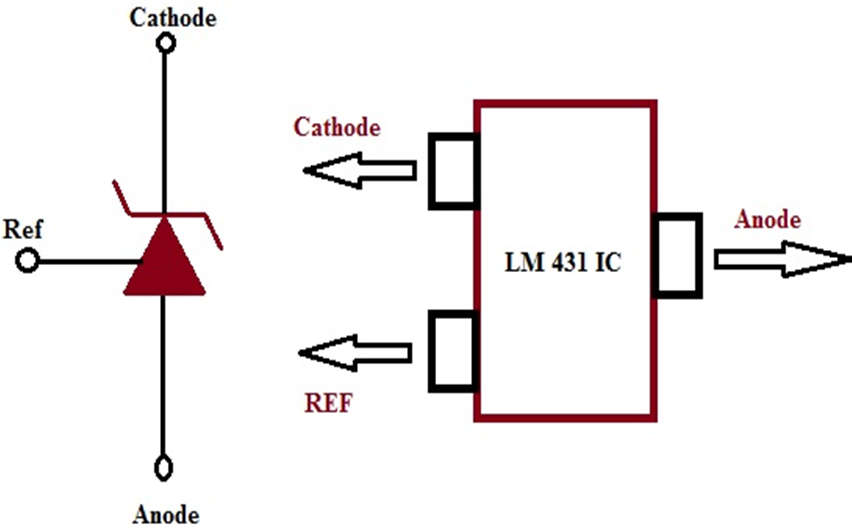
 

LM431 IC

Pin Configuration of LM431 IC

This IC includes three pins which are cathode, reference, and anode.

ADVERTISEMENT
Pins Description
Pin1 (Cathode): This is shunt current or o/p voltage
Pin2 (Reference): This pin is for adjustable o/p voltage
Pin3 (Anode): This pin is normally grounded

Application of LM431 IC

  • LM431 IC can be used for designing a circuit with a constant current source.
  • By connecting extra transistors as well as resistors to this IC, it can be used to design a high-power regulator.
  • By connecting extra resistors to this IC, it can be used to design a low-power shunt regulator.
  • This IC can be used to replace the Zener diode.
  • This IC can be used as the voltage regulator.
  • It is used in monitoring the voltage.
  • LM431 is used in sink circuits as well as current sources.
  • LM431 can be used for switching power supplies, and current linear or adjustable voltage.

Nikita Bisen

Nikita Bisen

Browse by Category

  • Aerospace and Defence
  • AI & Data Center
  • Articles
  • Automation
  • Automotive
  • Communication
  • Consumer-Electronics
  • Design & Manufacturing
  • Hardware & Software
  • Industrial Electronics
  • Interview
  • IoT
  • Knowledge Base
  • Lighting
  • Market
  • personal-electronics
  • Power Management
  • Research
  • Semiconductor Events
  • Semiconductor News
  • Sensors
  • Technology
  • Test and Measurement
  • Uncategorized
  • Wireless
Semiconductor For You

Semiconductor For You is a resource hub for electronics engineers and industrialist. With its blend of
technology features, news and new product information, Semiconductor For You keeps designers and
managers up to date with the fastest moving industry in the world.

Follow Us

Browse by Category

  • Aerospace and Defence
  • AI & Data Center
  • Articles
  • Automation
  • Automotive
  • Communication
  • Consumer-Electronics
  • Design & Manufacturing
  • Hardware & Software
  • Industrial Electronics
  • Interview
  • IoT
  • Knowledge Base
  • Lighting
  • Market
  • personal-electronics
  • Power Management
  • Research
  • Semiconductor Events
  • Semiconductor News
  • Sensors
  • Technology
  • Test and Measurement
  • Uncategorized
  • Wireless

Recent News

NVIDIA and KAIST Launch Joint AI Research Lab to Accelerate AI Innovation in Korea

NVIDIA and KAIST Launch Joint AI Research Lab to Accelerate AI Innovation in Korea

July 24, 2026
Beyond TOPS: Why Robotics Developers Need Integrated Sensing, Control, and Compute

Beyond TOPS: Why Robotics Developers Need Integrated Sensing, Control, and Compute

July 24, 2026
  • About
  • Advertise
  • Privacy & Policy
  • Contact

© 2026 Semiconductor For You

No Result
View All Result
  • Home
  • Semiconductor News
  • Technology
    • IoT
    • Wireless
    • Power Management
    • Automotive
    • Hardware & Software
  • Market
  • Interview
  • Knowledge Base
  • Tools
    • Resistor Color Code Calculator

© 2026 Semiconductor For You