
A Digital Multimeter (DMM) is one of the most commonly used pieces of electronic test equipment today. It is practically indispensable in electronics laboratories for home users, hobbyists, students, and professional electronics engineers.
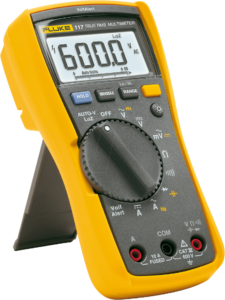

The price of digital multimeters varies widely. Some models are inexpensive yet offer excellent performance and accuracy, often far exceeding what is required for routine measurements. High-end digital multimeters with advanced specifications are also available for demanding industrial and laboratory applications.
Earlier, analogue multimeters were widely used, but today they are rarely seen. Digital multimeters have replaced them due to lower cost, higher accuracy, better reliability, and the ability to measure many more electrical parameters.
What is a Digital Multimeter?
A digital multimeter is an electronic measuring instrument used to measure electrical quantities such as voltage, current, and resistance. Unlike analogue meters, a DMM displays the measured value in numeric form on a digital display, making readings clear and unambiguous.
Basic digital multimeters measure:
- Voltage (AC and DC)
- Current (AC and DC)
- Resistance
Modern digital multimeters can also measure:
- Capacitance
- Frequency
- Continuity (with audible buzzer)
- Temperature
- Transistor gain
- Diode testing
Block Diagram of a Digital Multimeter
A typical digital multimeter consists of an input signal conditioning circuit, an analogue-to-digital converter (ADC), a processing unit, and a digital display.
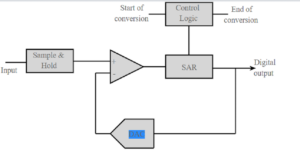
Block diagram of a DMM using successive approximation register ADC
Most DMMs use a Successive Approximation Register (SAR) ADC. This type of ADC converts the analogue input voltage into a digital value by successively approximating the input signal until the closest digital equivalent is obtained.
Controls and Connections of a Digital Multimeter
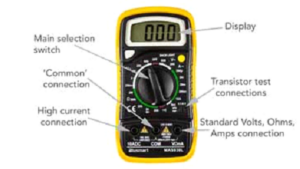
Digital multimeter showing the controls & connections
The front panel of a digital multimeter is usually simple and easy to operate. The layout may vary between models, but the basic controls remain similar.
Display
The display is usually an LCD with four digits. The most significant digit is often limited to 0 or 1. Additional indicators such as AC/DC, polarity (+/−), and battery status may also be present.
Input Terminals
A digital multimeter typically has three or four input terminals:
- Common (COM): Used for all measurements; the black probe is connected here.
- Voltage/Resistance/Frequency: Used for most measurements; the red probe is connected here.
- Current (mA/A): Used for measuring current; accepts the red probe.
- High Current Terminal: A separate terminal provided for measuring high currents.
Main Selector Switch
A rotary switch is provided to select the type of measurement and its range. This is the primary control used during measurement.
Additional Buttons
Some DMMs include extra buttons such as power on/off, hold, peak detection, or range selection.
How to Use a Digital Multimeter
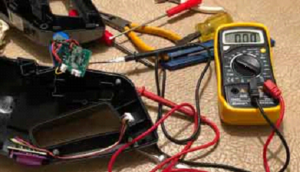
The basic steps for using a digital multimeter are:
- Turn on the multimeter.
- Insert the probes into the correct input terminals.
- Select the appropriate measurement type and range.
- If unsure, start with the highest range and reduce gradually.
- Take the measurement and note the reading.
- After use, return the probes to the voltage terminals and set the meter to the highest voltage range for safety.
Advantages of Digital Multimeter
- High input impedance, resulting in no loading effect
- High accuracy and reliability
- Clear and unambiguous digital display
- Compact size and portability
- Measures both AC and DC quantities
- Capable of measuring multiple electrical parameters
- Easy to use compared to analogue multimeters
Disadvantages of Digital Multimeter
- Requires battery or external power supply
- Low battery can cause dim or inaccurate display
- Limited voltage and current ratings
- More expensive than analogue multimeters
- Incorrect usage may damage the meter or cause personal injury
Conclusion
A digital multimeter is an essential tool for electrical and electronic measurements. Due to its accuracy, versatility, and ease of use, it has completely replaced analogue multimeters in most applications and is widely used in education, industry, and research.