
Introduction
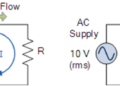
According to Ohm’s Law, an electrical current (I) flows between two points in a circuit when a voltage (V) is applied between them. This voltage creates a potential difference that drives the movement of electric charge. The amount of resistance (R) present in a circuit limits the amount of electrical current that can flow. In other words, resistance opposes the flow of current, while voltage promotes the movement of electric charge.
Electrical Resistance
Electrical resistance is measured in ohms (Ω), represented by the Greek letter Omega (Ω). For circuit analysis, we can often assume that wires have negligible resistance and omit their resistance from calculations because conductors such as wires and cables typically have very low resistance values.

On the other hand, insulators such as plastic and air generally have very high resistance. Therefore, their resistance can often be disregarded in basic circuit analysis because it is much higher than that of typical conductors. However, the electrical resistance between two points depends on several factors, including:
- The length of the conductor
- The cross-sectional area of the conductor
- The temperature of the conductor
- The material from which the conductor is made
Consider a single conductor having a length L, cross-sectional area A, and resistance R, as illustrated below.
A Single Conductor
According to Ohm’s Law, the electrical resistance R of a conductor depends on its length, cross-sectional area, and the material from which it is made. For a given resistance, the current flowing through a conductor is proportional to the applied voltage and can be expressed as:
I = V/R
For a uniform conductor, its resistance can be determined using the electrical resistivity equation.
Electrical Resistivity Equation
R = ρ(L/A) Ω
Where:
- R = Resistance in ohms (Ω)
- ρ = Resistivity of the material in ohm-metres (Ω·m)
- L = Length of the conductor in metres (m)
- A = Cross-sectional area of the conductor in square metres (m²)
The proportional constant ρ (the Greek letter rho) is known as resistivity.
Electrical Resistivity
Electrical resistivity describes how strongly a material opposes the flow of electric current through it. It is an important property of a material and is commonly represented by the Greek letter ρ (rho). Resistivity is also known as specific electrical resistance. It allows different materials to be compared based on their ability to resist the flow of electric current, independent of the conductor’s length and cross-sectional area. A material with a higher resistivity offers greater opposition to the flow of electric current, while a material with a lower resistivity offers less opposition to current flow.
Factors Affecting the Resistance of a Conductor
The resistance (R) of a conductor depends mainly on the following factors:
- Resistivity (ρ): The resistivity of the material from which the conductor is made.
- Length (L): The total length of the conductor. Resistance increases as the length of the conductor increases.
- Cross-sectional Area (A): The cross-sectional area of the conductor. Resistance decreases as the cross-sectional area increases.
- Temperature: The temperature of the conductor can affect its resistance. For most metallic conductors, resistance increases as temperature increases.
Relationship Between Resistance and Resistivity
The relationship between resistance, resistivity, length, and cross-sectional area is given by:
R = ρL/A
This equation shows that resistance is directly proportional to the length of the conductor and its resistivity, while it is inversely proportional to its cross-sectional area.
| Factor | Effect on Resistance |
|---|---|
| Resistivity (ρ) | Higher resistivity → Higher resistance |
| Length (L) | Greater length → Higher resistance |
| Cross-sectional area (A) | Greater area → Lower resistance |
| Temperature | Changes the resistance depending on the material |
Conclusion
Resistivity is an important electrical property that describes how strongly a material opposes the flow of electric current. The resistance of a conductor depends on its resistivity, length, cross-sectional area, and temperature. The basic relationship between these quantities is expressed by R = ρL/A. Understanding resistivity and the factors affecting resistance is essential for analysing electrical circuits and selecting suitable materials for electrical and electronic applications.